

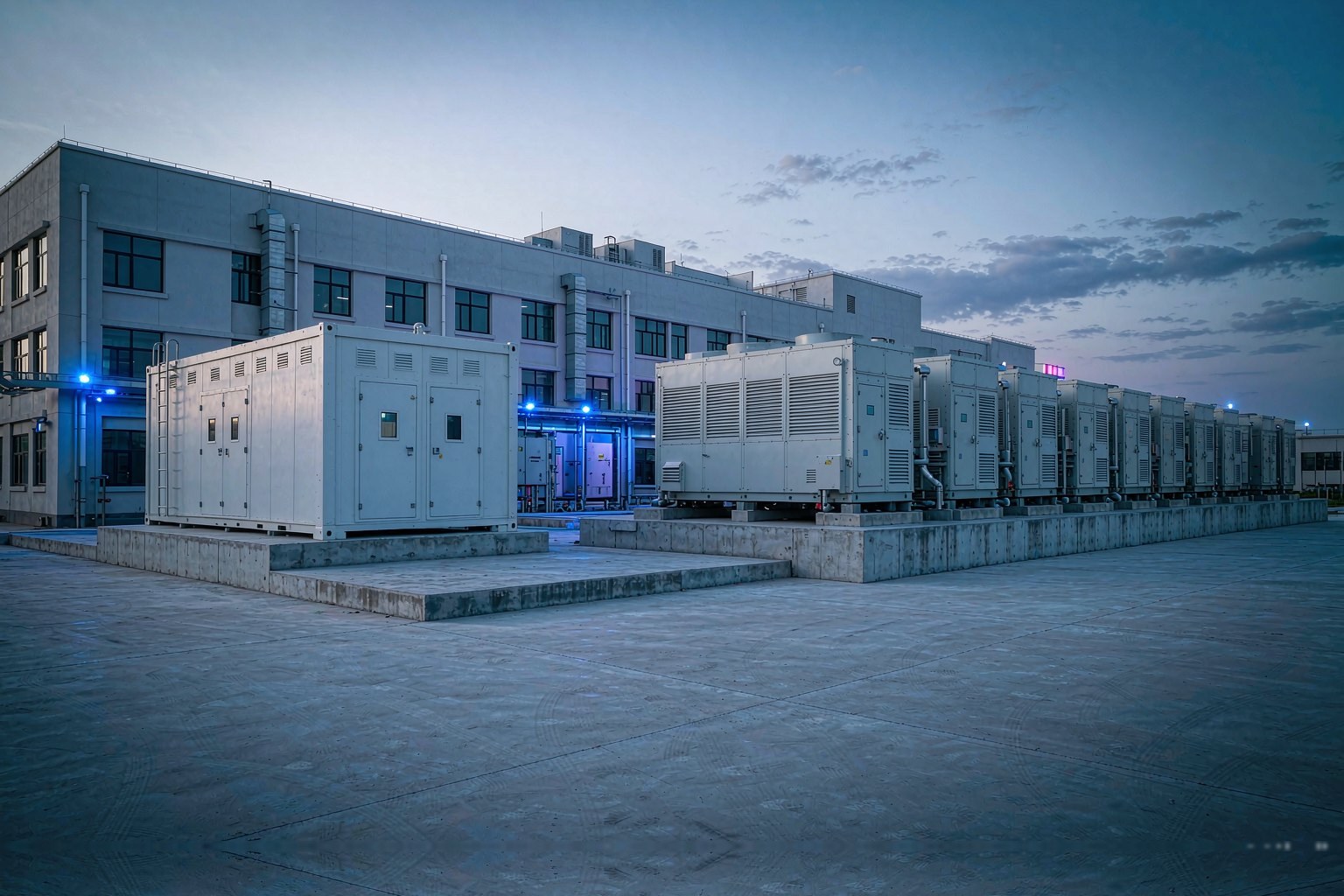
Data centres are, from a power engineer's perspective, a simple load with an unforgiving requirement: it must never stop. Hospitals, telecom exchanges, control rooms, and cold-chain facilities share the property to varying degrees. What differs is how many seconds of interruption each can tolerate, and how much it costs to be wrong.
The conventional answer — an uninterruptible power supply (UPS) holding the load for a few minutes, then a diesel generator carrying it for hours — has worked for decades and remains the baseline for good reason. But the operating environment has shifted. Diesel is harder to permit and harder to fuel reliably. UPS batteries are still valued for the seconds they buy, not for the energy they hold. And the same facility is being asked to cut energy costs and demand charges — tasks the backup equipment sits idle for, 99.9% of the time.
That is where battery energy storage becomes a dual-role asset: long-duration backup for critical loads, and a working asset for peak shaving and demand management in normal operation. The engineering question is not whether a BESS can do both. It is where the boundary sits between the UPS, the battery system, and the generator, and what has to be true for the combination to be as reliable as the single-purpose design it replaces.
Why the UPS-plus-generator architecture has limits
The classic chain is well understood: utility → UPS → critical load, with a generator starting on utility loss and taking over once stable. Each element has a known weakness.
The UPS battery holds minutes, not hours. Most data centre UPS batteries are sized for five to fifteen minutes — enough to bridge to the generator. That is adequate when the generator starts on the first attempt. It is not adequate when the generator fails, when fuel delivery is disrupted, or when the outage outlasts the fuel contract. Each event is rare; the combination is why facilities carry generator and fuel capacity they may never use.
Generator start time is not instantaneous. The transfer sequence allows seconds for start, stabilisation, and transfer, during which the UPS is the only source and the load depends entirely on a healthy battery.
Maintenance and testing are intrusive. Load-bank testing, battery impedance testing, and periodic transfer tests all carry risk, and some of the more serious outages in the sector have occurred during testing rather than a real event.
Emissions and permitting. Diesel generators face increasingly strict air quality rules, with limits on non-emergency run hours. In dense urban or water-stressed sites, siting a large generator set has itself become a project risk.
They earn nothing. A UPS and a generator are capital tied up against a low-probability event, while demand and capacity charges accrue every month.
None of this argues for removing the generator. It argues for not relying on only the generator, and for making the battery do more than bridge five minutes.
The division of labour: UPS, BESS, and generator
The most robust arrangements separate three functions and assign them explicitly.
| Function | Typical owner | Time scale | Design question |
|---|---|---|---|
| Sags, transfers, sub-second interruptions | UPS | Milliseconds to seconds | Transfer time, waveform quality |
| Bridging until the generator is stable; short outages | BESS | Seconds to hours | Autonomy, transition time, charge state |
| Long outages (many hours) | Generator, possibly with BESS support | Hours to days | Fuel autonomy, load stepping |
| Demand charges and arbitrage in normal operation | BESS | Hours | Cycle budget without compromising autonomy |
The critical design point is that the BESS and the UPS are not interchangeable. A UPS is optimised for power quality and instantaneous response; a large-format BESS is optimised for energy, cycle life, and cost per kilowatt-hour. Trying to substitute one for the other is where most conceptual confusion in this space begins.
Transition time: what actually has to happen, and how fast
Where an existing UPS already carries the load through transfers, the BESS enters as a second source rather than the primary ride-through device:
- Utility fails. The UPS carries the load, in milliseconds.
- The BESS detects the loss, opens its grid-side breaker, and enters island mode.
- The BESS picks up the critical bus — directly, or once the UPS has confirmed the new source is stable.
- A generator starts in parallel, if fitted, and the BESS hands over or continues to support the load.
Where the UPS is absent or being replaced, the BESS must provide the ride-through itself, and its transition time becomes the governing number. A static UPS transfers in milliseconds; a BESS with a static transfer switch can be designed to a similar order, but one relying on a mechanical breaker and inverter restart will not. Transition time must be specified and tested against the actual critical load, not inferred from a datasheet category.
Islanding and black start
Islanding means the BESS keeps supplying the critical bus while disconnected from the utility, which requires a defined islanding scheme, protection coordination, and a control mode that regulates voltage and frequency without a grid reference.
Black start means the BESS can energise a de-energised bus from a fully shut-down state. It requires the inverter to establish a voltage and frequency reference and to sequence load pickup gradually, because a large block of load applied at once would trip the source.
For a data centre, islanding is the commonly exercised capability; black start is the rare but decisive one. Both should be demonstrated at commissioning with a real load.
N+1 and the redundancy question
Critical facilities are usually designed around N+1: one more module than the load requires, so a single failure does not reduce capacity. Applying this to a BESS is not simply "add one more container." Redundancy must be defined at the level where a failure actually matters:
- Rack level. A failed rack reduces capacity, and the system continues at reduced autonomy.
- PCS or cabinet level. A failed PCS removes power capability, so critical-load applications usually need N+1 at the PCS level.
- System level. Two independent units, each able to carry the critical bus alone, is the strongest arrangement but doubles capital.
The right question is not "how many units" but "what autonomy do we retain after the worst single failure?" A facility sized for 60 minutes that drops to 45 is accepting a calculated risk; one that drops to four minutes is not.
UPS batteries and BESS batteries are not the same component
This distinction matters during procurement, because the two are often compared on price per kilowatt-hour — the wrong comparison.
| UPS battery | Large-format BESS | |
|---|---|---|
| Primary duty | Float at full charge, discharge rarely and briefly | Charge and discharge daily |
| Design lifetime | Calendar life, often 3–5 years for VRLA | Cycle life, typically 10 years or more |
| C-rate | Often high (10-minute rates) | Moderate; 0.5C typical for container systems |
| Discharge depth | Usually shallow in practice | Deep and repeated |
| Monitoring | String-level impedance; cell-level in better designs | Cell-level temperature, voltage, gas detection |
A UPS battery spends its life doing almost nothing, then does something extremely demanding. A BESS does moderate work constantly. They fail differently and are specified differently. A BESS used as a straight replacement for a UPS battery bank ignores C-rate and response requirements; UPS batteries used as a BESS energy source ignore cycle life.
Sizing autonomy: what 15 minutes, 1 hour, and 4 hours actually mean
Autonomy most directly determines cost, and it is also most often chosen by habit. It is worth being explicit about what each duration buys.
| Autonomy | What it covers | Typical fit | Main constraint |
|---|---|---|---|
| ~15 minutes | Bridging to generator; switching and short outages | Facilities with reliable generators and short utility outages | Thin margin if the generator fails |
| ~1 hour | Generator start plus a likely switching sequence; ride-through without the generator | Sites with unreliable generator start, or where the generator's role is being reduced | Fuel-free ride-through, but not full outage coverage |
| ~4 hours | Multi-hour outage coverage; generator deferral or removal | Long outages, fuel logistics risk, or generator constraints | Cost and footprint; requires real cycle and thermal design |
The figures below are illustrative only, showing how autonomy translates into scale for an assumed critical load. They are not a project estimate; actual sizing depends on measured load, power factor, permissible depth of discharge, and required end-of-life capacity.
| Parameter | Illustrative value |
|---|---|
| Critical load | 1.0 MW average, 1.2 MW peak |
| Autonomy required | 4 hours |
| Energy required at load | 4,000 kWh |
| Allowance for DoD, degradation, and PCS losses | Assumed 1.2× |
| Indicative installed energy | ≈ 4,800 kWh |
| Indicative configuration | One 5.01 MWh liquid-cooled container |
| Indicative duration at 1.2 MW peak | ≈ 4.2 hours |
The purpose of the 1.2× allowance is that a 5.01 MWh system does not deliver 5.01 MWh to the load: depth-of-discharge limits, end-of-life fade, and PCS losses consume part of it. Quoting nameplate energy as available autonomy is a common early-stage error.
Where large-format containers fit
For megawatt-scale facilities — a colocation hall, a hospital campus, a telecom core site — the relevant unit is a container, not a cabinet. The 5.01 MWh liquid-cooled system is designed for this scale: LFP cells at 3.2 V / 314 Ah in a 1P416S × 12 configuration, rated 5.01 MWh at nominal 1,331.2 V, with 0.5C maximum charge and discharge and a voltage range of 1,164.8–1,497.6 V.
Three properties matter specifically in a critical-power context.
Safety architecture. A critical facility cannot afford a fire event in its backup system. The container includes temperature sensors, smoke detection, combustible gas detection, deflagration venting, gas suppression, and water sprinkler — detection and mitigation at several levels rather than a single mechanism.
Environmental envelope. Sites range from tropical to cold-climate, at altitude. The container is rated for −30°C to 50°C, ≤95% RH non-condensing, and up to 3,000 m; a container that cannot hold its rating at the site becomes a derated asset.
Acoustic and physical footprint. At ≤80 dB(A) at 1 m, with a 75 dB option, it sites near buildings and boundaries more readily than a large generator set. At 6,058 × 2,438 × 2,896 mm and approximately 42,000 kg, it is a standard ISO footprint, but it needs a foundation and access plan settled before delivery.
Ingress protection is IP55 with C4 corrosion rating as standard and C5 optional for coastal or chemically aggressive sites. Communications are Ethernet / CAN / RS485, which lets the BESS integrate into the facility's DCIM or SCADA layer rather than operating as a standalone island of data.
Tier context: what the standards do and do not say
The Uptime Institute Tier classification and the TIA-942 and EN 50600 standards are commonly invoked when specifying backup, and are frequently misread in conversations about batteries.
The Tier system describes topology and fault tolerance — redundant capacity components and distribution paths, and whether maintenance can be performed without shutting down the load. It does not prescribe a battery chemistry, an autonomy duration, or a transition time; those come from the operator's risk assessment, the applicable code, and the load's tolerance.
Two implications follow. First, a BESS does not by itself raise a Tier level. Tier is a property of the whole power path, including the UPS, the distribution, and the maintenance bypass arrangements. Second, concurrent maintainability applies to the BESS too. If storage cannot be maintained or a module replaced without affecting the critical bus, it introduces a new single point of failure into a facility designed to avoid them — the strongest argument for N+1 at the PCS or system level.
Use the standards to frame the reliability requirement and the load study and outage history to set autonomy. Do not use a Tier label as a substitute for either.
Load segmentation: not everything needs four hours
A design that gives every load the same autonomy is usually over-built in some places and under-built in others. Three tiers are usually enough:
Tier 1 — must never drop. Controls, networking, security systems, the monitoring operators need to respond. This is UPS territory.
Tier 2 — must ride through transfers and short outages. IT load, medical equipment, process control, telecom transmission. This is where a BESS with one-hour autonomy and a defined islanding scheme earns its place.
Tier 3 — can be shed or supported briefly. HVAC, chillers, non-critical pumps. Often the largest load and the one that determines generator size. Shedding or soft-sequencing this tier during an outage extends the autonomy available to Tiers 1 and 2 — a control function, not a capacity purchase.
This is also where the dual-role logic becomes precise. The BESS can serve Tier 2 load during an outage and the whole site for demand control and peak shaving in normal operation, provided the control logic reserves enough state of charge for critical load before committing energy to arbitrage. That reservation must be an explicit, auditable setpoint.
Design and commissioning checklist
- Measure the actual critical load, including power factor and inrush, rather than relying on nameplate ratings.
- Define autonomy at end of life, not beginning of life, and state the depth of discharge allowed.
- Specify transition time and demonstrate it with a real transfer using the actual critical load.
- Test islanding and black start separately, each with a site-representative load sequence.
- Confirm the N+1 definition by simulating the loss of one PCS or container and verifying retained autonomy.
- Verify protection coordination between BESS, UPS, generator, and utility incomer — changing the source changes fault levels.
- Document the state-of-charge reserve and test that peak-shaving commands cannot breach it.
- Set the maintenance plan for coolant, detection, and suppression, and confirm it can run without affecting the critical bus.
FAQ
Can a BESS replace the UPS entirely?
In some designs, particularly where the critical load tolerates the BESS transition time and the BESS is specified for high power quality and fast response. In most existing data centres the practical approach is to keep the UPS for sub-second ride-through and use the BESS for longer autonomy. The decision rests on the load's measured tolerance, not on capital cost alone.
How long should the battery hold the load?
Long enough to cover the credible outage duration given generator reliability and fuel logistics — commonly one hour where generators are dependable, longer where they are not. Fifteen minutes is a bridge to a generator, not an autonomy target.
Does storage let us remove the diesel generator?
It can reduce generator run hours or defer a replacement, but removing the generator entirely requires an autonomy and fuel-logistics assessment most data centre operators will not accept for a multi-hour outage. A more defensible position is that storage reduces dependence on the generator for short events and improves resilience when it fails.
How does a BESS coexist with the demand charge objective?
By treating critical-load autonomy as a reserved block of energy. The EMS may shave peaks and arbitrage above that reserve, but the reserve itself is not available to the optimisation. This has to be configured and tested; a schedule that ignores the reserve can leave the site short of energy when the grid fails.
Is Tier certification affected?
Tier is a topology and fault-tolerance classification, not a battery specification. A BESS must be reviewed as part of the power path — particularly for concurrent maintainability — but it does not independently raise or lower a Tier rating. Work with the certification body on the topology change rather than treating storage as a bolt-on.
What to do next
For a critical facility, the first deliverable is not equipment selection. It is a load and outage study: which loads must never drop, how long each tolerates an interruption, how reliable the generator and fuel supply actually are, and what the credible worst case looks like. Autonomy follows, and system scale follows from autonomy.
BR SOLAR supplies both ends of the range — the BR-261 100 kW / 261 kWh liquid-cooled cabinet for site-level critical loads and smaller facilities, and the 5.01 MWh liquid-cooled container system for megawatt-scale installations, with LFP cells, multi-level fire detection and suppression, a −30°C to 50°C operating envelope, and Ethernet / CAN / RS485 integration into facility monitoring. Share your critical load profile and outage requirements, and the autonomy and redundancy review can start from there.






