

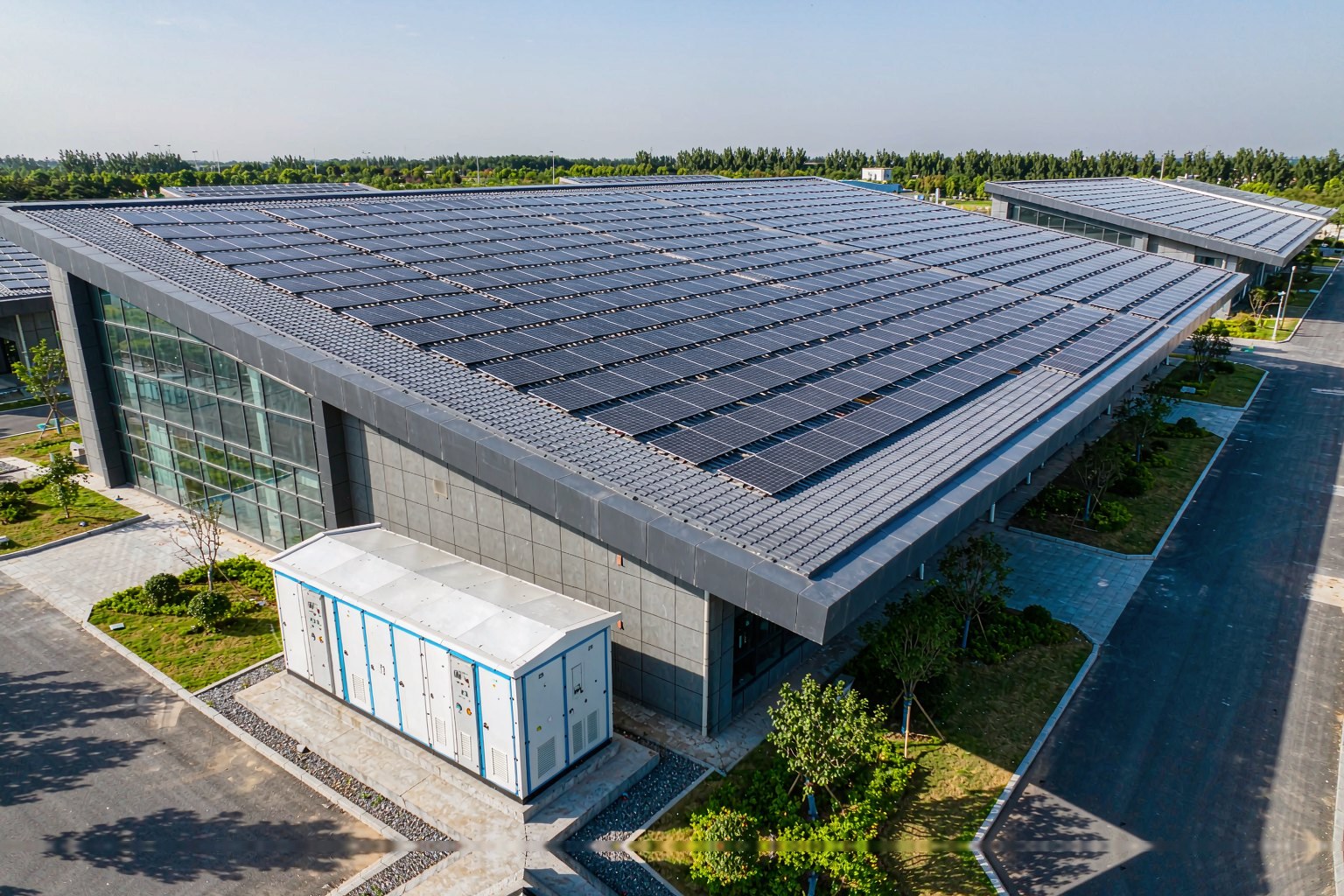
Rooftop PV is now standard equipment on industrial buildings. The economics are understood, and for most plant owners the decision was made years ago. What is less settled is the second question, which usually arrives a year or two after commissioning: the panels are generating, the meter confirms it, and yet the bill did not fall as much as the proposal suggested.
The reason is rarely the PV system. It is that the PV system and the factory are not using electricity at the same time.
Pairing PV with storage — solar plus storage — does not make the panels generate more. It changes when that generation is used, and it changes what the grid connection sees. For C&I sites, that second effect increasingly determines whether an expansion is permitted at all.
The two curves do not line up
A PV array produces a bell curve centred on solar noon. A factory consumes according to shift patterns, batch cycles, and HVAC. The overlap is partial, and the mismatch shows up in three recurring ways.
Midday surplus on low-load days. A single-shift plant may hit peak PV output while part of the line is idle. If the site shuts at weekends, the array keeps producing into almost no load.
Evening peaks with no PV. Industrial loads often peak in the late afternoon or evening, where the tariff peak window often sits and PV output is already falling. The most expensive kilowatt-hours are the ones the array cannot cover.
Seasonal asymmetry. In higher latitudes, generation concentrates in months when the plant may run a reduced schedule, while consumption peaks when there is least sun.
The metric that captures this is the self-consumption ratio — the share of PV generation consumed on site rather than exported. A plant with a 24-hour process load and a modest array may self-consume 80–90%. A single-shift plant with a large array can fall below 50%, meaning most of the generated energy leaves the site at whatever the export price happens to be.
What happens to the surplus, and why it is worth less now
Export was once the easy answer. Feed-in tariffs, or net metering at the retail rate, meant an exported kilowatt-hour was worth roughly the same as one not consumed.
That has changed in most markets, and the direction of travel is consistent. Export compensation has moved toward net billing at a price nearer wholesale or avoided cost, sometimes with time-of-day variation paying almost nothing at midday — precisely when C&I arrays export most. In parallel, distribution operators in a number of regions now apply export limits or require curtailment capability as a condition of connection.
The implication is that the value of PV is increasingly set by how much of it the site can absorb. That is the gap storage fills, and why the case for adding a battery to an existing array is often stronger than the case for enlarging the array.
The figures below are illustrative only, built on assumed generation and tariff values, and show the shape of the calculation rather than a promised return. Actual results depend on local irradiance, tariff structure, export rules, and load profile.
| Item | Basis | Illustrative result |
|---|---|---|
| Rooftop PV capacity | Assumed 500 kWp | — |
| Annual generation | Assumed 1,100 kWh/kWp/yr | 550,000 kWh/yr |
| Self-consumption without storage | Assumed 60% | 330,000 kWh/yr |
| Export without storage | Remainder | 220,000 kWh/yr |
| Self-consumption with storage | Assumed 85% | 467,500 kWh/yr |
| Additional energy self-consumed | Difference | 137,500 kWh/yr |
| Value of that shift | Assumed $0.09/kWh import-to-export spread | ≈ $12,400/yr |
The spread in the last row is the number to check first, because it varies enormously. Where exports are still compensated at or near the retail rate, storage adds little on this line and the case has to rest on demand charges or backup instead.
Three grid constraints that arrive with PV
Beyond the tariff, there are connection conditions that a battery can resolve and that an array alone cannot.
Reverse power and anti-backflow. Some connection agreements prohibit export, or permit it only up to a small threshold, because the local network cannot absorb it. Conventional compliance means curtailing the inverters — discarding generation. Storage turns curtailment into charging, and the site keeps the energy.
Ramp rate from cloud transients. A passing cloud can drop a large array's output by most of its capacity within seconds. On a weak feeder that is a power quality problem, and some operators now specify a maximum ramp rate. A battery following the inverse of the PV ramp smooths net output at the connection point.
Voltage rise at the point of connection. High PV output into a lightly loaded feeder raises voltage, sometimes past statutory limits, again leading to curtailment. Absorbing the surplus locally addresses the cause rather than the symptom.
None of these are arguments against PV. They are why a PV project that was straightforward five years ago now arrives with a longer list of connection conditions, and why storage is increasingly part of the connection design.
AC-coupled or DC-coupled
The first architectural decision is where the battery meets the PV system.
| DC-coupled | AC-coupled | |
|---|---|---|
| Connection point | Battery and PV share a DC bus before the PV inverter(s) | Battery has its own PCS and connects on the AC bus |
| Best suited to | New builds, where PV and storage are designed together | Retrofits to an existing, operating PV system |
| Clipped PV energy | Can capture energy the PV inverter would otherwise clip | Clipped energy is lost before the AC bus |
| Conversion stages | Fewer for PV-to-battery, more for battery-to-grid | One DC/AC stage each way for the battery |
| Independent operation | Battery and PV control are tightly coupled | Battery can charge from the grid, discharge to load, or do demand control independently |
| Expansion | Tied to the original PV inverter capacity | Battery capacity can grow without touching the PV plant |
For most C&I retrofits — an operating array, an existing inverter room, an owner who does not want to disturb a working asset — AC coupling is the pragmatic answer. It leaves the PV system untouched, adds a single AC connection, and leaves the battery free to perform functions unrelated to solar: peak shaving, demand control, backup.
DC coupling usually wins on new builds with large DC-side clipping, where the array is deliberately oversized relative to the inverter. The conversion losses avoided are real, but smaller than the flexibility given up, and should be quantified before deciding on efficiency grounds alone.
Sizing: from PV capacity and load curve to kW and kWh
Sizing means answering two separate questions, in this order.
How much power (kW)? Power rating is set by the rate at which surplus or deficit must be absorbed or supplied. Start from the maximum sustained gap between PV output and site load. If the load is 900 kW and the array delivers 700 kW at noon, the 200 kW deficit is a peak-shaving duty, not a solar-charging duty. If the load drops to 200 kW at the weekend while the array delivers 500 kW, the 300 kW surplus sets the required charge rate.
How much energy (kWh)? Energy rating is set by duration. Integrate the surplus hours and the deficit hours across the day. A system absorbing midday surplus for release into the evening peak typically lands in the two-to-four-hour range at rated power; one flattening cloud transients needs far more power than energy.
The ratio between PV and storage capacity is therefore not a rule of thumb to be copied from another site. It follows from the overlap of two curves, and two plants with identical arrays can need very different batteries.
EMS priority logic: what happens when the objectives collide
Once PV and storage share a connection, the controller has several masters. A clear priority hierarchy stops the system working against itself, and it should be written into the specification.
For most C&I sites the order is:
- Maximize self-consumption of PV. Charge from surplus PV rather than exporting; discharge to cover site load rather than importing.
- Demand control. Keep net import below the agreed limit. This overrides pure self-consumption when the two conflict, because a missed interval costs the whole month.
- Peak-window discharge. Use remaining capability to displace import inside the expensive tariff window.
- Off-peak charging from the grid. Only afterwards, and only if the arbitrage economics remain positive after losses.
Two conflicts are worth flagging. If the battery is full by 11:00 from PV surplus, it has no headroom for a midday export-limitation event — so the state-of-charge ceiling during risk hours matters as much as the floor. And where a cheap off-peak window exists, charging from the grid may beat charging from exportable PV; the controller needs the export price to evaluate that, not just the import price.
This is a configuration exercise, not a hardware feature. The platform must expose the setpoints and allow the priorities to be reordered as the tariff changes.
What to check at the grid connection point
Solar-plus-storage projects fail at the connection point more often than at the battery. Points that belong in the design review:
Metering and CT placement. The EMS can only control what it measures. To manage net import it needs a measurement at the point of common coupling that sees PV, load, and storage together — not a CT on a single feeder. This is the most common commissioning defect in retrofit projects.
Protection coordination. Adding a second source and a bidirectional inverter changes fault contributions, and relay settings on the existing incomer may need revisiting.
Anti-islanding. Grid-tied inverters and PCS units must disconnect on loss of mains. Any backup capability requires a defined islanding scheme with a protected loads bus, designed in from the start rather than enabled later.
Power quality. With PV inverters, drives, and a PCS on the same bus, harmonic interaction is a real consideration. A power factor range of −0.99 to +0.99 with THDi ≤3%, plus AC-side residual current detection and lightning protection with fault alarming, is the baseline most distribution operators accept.
Equipment considerations for a co-located system
One controller, not three. PV inverter, PCS, and BMS each have their own logic. Coordinating them through an external gateway adds latency and another failure point. The BR-261 integrates EMS, PCS, and BMS in a single enclosure, reducing the integration surface to one AC connection and one set of control setpoints.
Communication flexibility. The EMS must exchange data with existing PV monitoring and the site's SCADA or energy management system. ETH / 4G / CAN / RS485 / LAN support, with cloud-edge coordination, covers most retrofits without a bespoke gateway.
Outdoor siting. PV-plus-storage systems are often placed outdoors near the inverter room or substation, which means IP55 ingress protection and C4 corrosion rating, with C5 for coastal or chemically aggressive sites. The BR-261's −20°C to 55°C operating range (charging 0–55°C) covers most industrial climates; its liquid-cooled thermal system holds maximum cell temperature ≤38°C at full power with cell temperature difference ≤3°C, and includes low-temperature heating where charging would otherwise be constrained.
Room to grow. PV capacity often expands in phases. The BR-261 supports up to 8 units in parallel, so storage can follow the array without a change of control architecture.
Duty profile. The BR-261 uses 3.2 V / 314 Ah LFP cells. In PV-coupled duty the cycling pattern is solar-shaped rather than tariff-shaped — one main charge per day with shallower, more irregular events layered on top — and the cycle-life guarantee should be read against that pattern.
Commissioning checklist
- Verify the measurement point against a known PV output: confirm the EMS reads net import correctly, and in the right direction.
- Test the export limitation under a real surplus condition and confirm the utility's export meter agrees.
- Step through the priority hierarchy and confirm a demand-limit event overrides a self-consumption charge command.
- Check ramp-rate behaviour on a partly cloudy day and record net output at the connection point.
- Confirm anti-islanding and reconnection timing at the operator's witness test where required.
- Record baseline thermal data so later comparisons mean something.
FAQ
Do we need storage if we already export at a good rate?
Probably not for self-consumption reasons. Where export is compensated close to the retail rate, the difference between exporting now and consuming later is thin, and the case has to rest on demand charges, backup, or a connection constraint. Re-check the export terms annually; they have been moving in one direction.
Can we add storage to an existing PV system without touching it?
Yes, in an AC-coupled configuration. The battery connects on the AC side with its own PCS and the PV plant continues to operate as before. The main work is metering at the point of common coupling and, in some jurisdictions, a connection agreement amendment.
How do we size the battery against the array?
From the overlap of the two curves, not from a ratio. Power is set by the largest sustained surplus or deficit; energy by how long that condition lasts. Two sites with the same array can reasonably end up with different batteries.
Will storage let us install more PV than the connection allows?
Sometimes. Where the constraint is an export limit, a battery absorbing the surplus can make a larger array admissible — but this must be agreed with the distribution operator in the connection application, and the control scheme usually has to be demonstrated.
Does the battery charge from solar or from the grid?
Both, depending on control strategy and tariff. Charging from surplus PV avoids a low export price; charging in the off-peak window may be cheaper still after losses. A well-configured EMS compares the two against the export price and the next day's state-of-charge requirements.
What to do next
If you already have PV, the useful first step is not a battery quote. It is a single graph: one year of site load and PV output on the same axes at 15-minute resolution, with tariff windows overlaid. That graph shows where the surplus goes, where the deficit is bought at the peak price, and whether the real constraint is economic or a connection condition.
BR SOLAR's BR-261 all-in-one cabinet is designed for exactly this retrofit pattern — EMS, PCS, and BMS integrated in one IP55 enclosure, AC-coupled to the existing plant, with LFP cells, liquid cooling, and up to 8 units in parallel. Send the load profile, the PV production data, and the tariff structure, and the sizing review can begin there.
Related reading
- C&I Energy Storage ROI: Payback, LCOS and Value Stacking — how the four value streams, payback and LCOS maths turn a dispatch strategy into a number your finance team will sign off on.






