

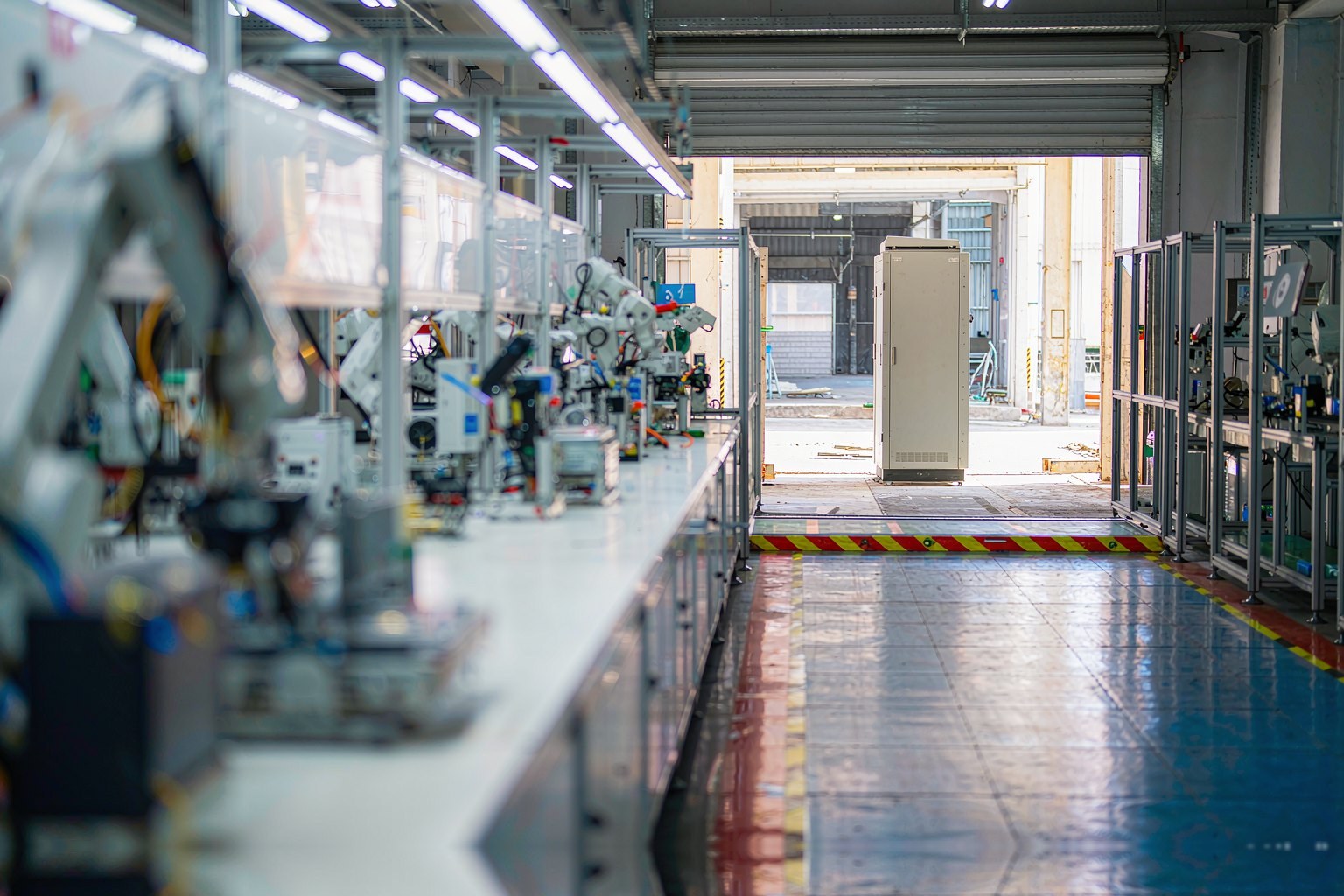
A voltage sag lasting a fraction of a second can stop an automated line for hours. The energy the plant failed to receive may be worth a few cents. The consequence — a robot that lost position, a spindle that crashed, a furnace that aborted its cycle, a batch scrapped — is worth far more, and none of it appears on the electricity bill.
That mismatch is why the standard peak-shaving case often fails to gain traction in plants running precision machining, electronics assembly, automated welding or continuous process lines. When management compares the cost of one disturbance against a year of tariff arbitrage, arbitrage usually loses. The more expensive problem has never been put on the same page as the battery quote.
This article separates sags from interruptions, explains what tolerance curves do and do not tell you, and sets out how disturbance duty is divided between storage, UPS, regulators and filters.
The bill is the wrong frame for sensitive production
Energy costs are visible: they arrive monthly, coded to a cost centre, with an accountable owner. Disturbance costs are not. They are scattered across scrap accounts, overtime, maintenance labour, quality rework and expedited freight, and across the informal knowledge that one line "always has trouble in storm season."
So the first exercise is to reconstruct the last four quarters of disturbance events and attribute costs to consistent categories: scrap and work-in-progress lost at the moment; restart and re-qualification time; tooling damage; schedule recovery through overtime; and customer-facing consequences such as missed delivery windows.
The point is not a precise number. It is to establish that this cost is structurally different from an energy saving, and that it belongs to a different budget owner.
Voltage sag and short interruption are different problems
A voltage sag is a temporary reduction in RMS voltage below a defined threshold, followed by recovery. It is usually caused by a fault elsewhere on the network — a short circuit on an adjacent feeder, a lightning strike, vegetation contact — which protection then clears. While the fault persists, voltage across a wide area is depressed. The supply never disappears; it is out of specification.
A short interruption is a drop to near zero voltage followed by restoration: protection disconnects the circuit, an automatic recloser opens and recloses, or a transfer to an alternate source takes place. The load is separated from the source, however briefly.
The consequence for equipment selection is direct. During a sag the grid is still connected, so the response is support: hold plant bus voltage within the tolerance of the connected equipment. During an interruption the response is transfer: supply critical load from a local source.
Voltage swells, transients, harmonic distortion and unbalance are separate problems, none solved by adding energy capacity. Thresholds differ between standards and jurisdictions, so cite the standard that applies to your site.
What tolerance curves actually tell you
The ITIC curve — successor to the original CBEMA curve — plots voltage magnitude against event duration and describes an envelope within which typical information-technology equipment is expected to keep operating. It is useful, with three caveats that matter in procurement.
It is a reference envelope, not a guarantee. It was developed for a class of equipment, not for your machine tools, robots, drives or process controllers, and no manufacturer certifies to it by default.
It describes equipment input terminals, not the incoming supply. Voltage at a sensitive controller depends on transformer impedance, cable lengths, loading at the time and what else shares the bus.
A line is only as tolerant as its weakest device. The equipment that trips first is often not the expensive process tool but a contactor that dropped out or a controller supply that reached its hold-up limit.
So the productive question for vendors is not "does it meet the curve?" but "what is the ride-through capability of this device, at its input terminals, in our configuration?" Some devices can be upgraded cheaply — a ride-through module on a control circuit, a re-specified contactor coil. A small control-circuit fix sometimes removes the most sensitive node in the chain, so it is worth asking before specifying a battery.
Where events come from
Establish whether events are external or internal before specifying anything. Upstream network faults are the most common cause of deep sags and cannot be prevented on site; the options are ride-through equipment, local generation and storage, or accepting the consequence. Internal events — motor starting, resistance welding, large compressors — are usually cheaper to fix at source with soft starters, start sequencing, or a dedicated feeder.
A power quality analyser at the incoming supply and at one or two sensitive busbars, logging for several weeks, normally settles the question. Plants that skip this step tend to buy equipment for the wrong problem.
Storage as an active support resource
A battery system is not only stored energy. The power conversion system (PCS) in front of the battery is a grid-connected power electronic converter, and that is what makes it useful during a sag. A converter has no rotating mass; its control loop acts on a millisecond timescale rather than the seconds-to-minutes timescale of a standby generator. Within its current rating it can inject or absorb active and reactive current in response to a disturbance, supporting bus voltage while the grid is still connected and holding load through a short interruption if islanding is specified.
This is the same class of capability that grid codes in many markets now require from distribution-connected converters.
Two cautions follow. Millisecond-scale behaviour is a control-system property, so response figures and transfer times must come from the supplier's documentation for the specific model. And ask for the sequence, not the feature name: what happens at the instant of the event, in what order, and what happens if the event runs longer than the reserve allows. A documented sequence is testable at commissioning; a feature name is not.
Division of labour: storage, UPS, regulators, filters, generators
The most common specification error is asking one device to solve every power quality problem. It produces an oversized solution that still leaves gaps. The layers are complementary.
| Layer | Covers | Limited by |
|---|---|---|
| UPS | Sags, short interruptions, some transients; seconds to tens of minutes | Defined critical load, not a whole plant; battery replacement cycle |
| Voltage regulator / AVR | Long-duration under- or over-voltage, shallow sags | Little stored energy; no support during an interruption |
| Harmonic filter | Steady-state distortion, power factor | No ride-through capability |
| BESS with grid-support PCS | Sags while connected; interruptions if islanding is specified | Converter current rating, stored energy, and state of charge if also peak shaving |
| Standby generator | Outages from tens of seconds to days | Start delay needs a bridging source; fuel, maintenance, permitting |
The storage row is the one that surprises procurement teams. A battery cycling daily for peak shaving has no obligation to be full when a sag arrives. If ride-through is also required, the EMS needs an explicit reserve policy — a minimum state of charge held for disturbance duty and a recharge priority afterwards. Without it the two functions compete, and the one that loses is the one nobody was measuring.
Power quality the converter itself contributes
A poorly specified converter makes matters worse: it injects harmonics, distorts voltage at a sensitive bus, interacts with existing capacitor banks, or presents a poor power factor. In a plant that already has power quality problems, that is unacceptable.
The figures worth writing into an enquiry are the ones that constrain this behaviour. On the BR-261 platform the PCS is specified at THDi ≤ 3%, with a power factor range of −0.99 to +0.99 and rated current 144 A, on a 380/400 Vac, 50/60 Hz, three-phase five-wire connection. Those are what allow a cabinet to sit on a bus serving sensitive equipment without becoming a new source of disturbance.
If the plant expects to grow, confirm how the EMS coordinates multiple units — the BR-261 supports up to 8 units in parallel, which raises questions about circulating currents and coordinated response. Confirm AC-side protection too: Class II lightning protection with fault alarming and residual current detection are baseline items.
Sizing is power-dominated, not energy-dominated
Peak shaving is usually an energy problem. Disturbance response is a power problem that acquires an energy requirement based on a business decision.
| Event class | Order of duration | Plant consequence (illustrative) | What it demands from storage |
|---|---|---|---|
| Deep voltage sag | Cycles to a few seconds | Drives trip, controllers reset, line stops | Converter current rating and control response |
| Short interruption | Seconds to a few minutes | Line stops; restart and re-qualification | Islanding capability, protected bus, kW headroom |
| Sustained outage | Minutes to hours | Production lost; schedule recovery | Energy capacity, larger by an order of magnitude |
| Continuous distortion | Ongoing | Nuisance trips, heating, premature failure | Not a storage function; filtering |
The duration you design for sets the size, and it is a business decision. Ten seconds bridges a transfer; a few minutes allow a controlled stop rather than a crash; half an hour allows a batch to finish. Each step costs energy capacity, and the last costs a great deal of it. Decide it with operations; a supplier's default model will select the duration that makes the quote look competitive.
Why continuity is often easier to approve than arbitrage
The arbitrage case has one owner, typically finance or energy management, and one input that can change without notice: the tariff. A revision narrowing the peak-to-valley spread can weaken the case after installation.
The continuity case behaves differently. The loss already has an owner — production, quality or maintenance has been recording these events, and the incident log is evidence. It is framed as risk reduction rather than financial return, so it does not depend on a payback calculation and does not become invalid when tariffs move. It also connects to customer requirements, since automotive, medical and electronics customers audit delivery reliability, and a documented mitigation measure is a concrete answer in a qualification review.
That is not an argument for inflating the continuity case, but for writing it down with assumptions visible: which loads are protected, for how long, and under what state-of-charge policy.
Site and commissioning notes
- Define the protected bus and load priority list before design freeze; everything downstream depends on it.
- Test the sequence at commissioning with production present, using a simulated event or controlled transfer, and record the result.
- Instrument before and after. Without a baseline event count nobody can demonstrate improvement; make the EMS event log a KPI.
- Write the reserve policy into the EMS, including recharge priority and degraded-mode behaviour.
- Route alarms to a named person, not only to a dashboard.
For siting, an outdoor IP55 enclosure with C4 corrosion rating suits most industrial environments; chemically aggressive or coastal sites may need C5. The BR-261 operates from −20°C to 55°C, with charging limited to 0–55°C, and includes a low-temperature heating function. Fire protection should be specified at more than one level: pack-level and system-level aerosol suppression, 50 mm rock wool with a one-hour fire resistance rating, and an explosion-proof cabinet.
FAQ
Can a battery system replace our existing UPS?
Usually no, and the attempt is rarely worthwhile. A UPS protects a defined critical load with guaranteed transfer behaviour and its own battery, and does that job well. Storage suits larger loads, whole-bus support, and sites that also want peak shaving. The common design keeps the UPS on control systems and servers, and uses storage for the wider plant.
How do we confirm we actually have a power quality problem?
Install a power quality analyser at the incoming supply and at sensitive busbars, log for several weeks, and correlate events with nuisance drive trips, unexplained resets and restart entries in the maintenance log. Many plants find a meaningful share of events originate on site and can be fixed with motor starting changes or feeder separation.
Does storage deal with harmonics?
Not by default. A well-specified PCS must not make distortion worse — the BR-261 is specified at THDi ≤ 3% — but harmonic mitigation is a separate measure using filters, scoped separately if distortion is part of the problem.
Will the battery always be ready when an event occurs?
Only if the operating policy requires it. If the system is also cycling for peak shaving, the EMS needs a minimum state-of-charge reserve held for disturbance duty, plus a recharge priority after an event. That belongs in the functional specification and should be verified at commissioning.
What to do next
If sensitive production is the driver, the most useful first step is not a quote. It is a power quality survey combined with last year's disturbance log. Together they show whether the problem is external or internal and what duration of support would have prevented the losses that mattered.
BR SOLAR's BR-261 100 kW / 261 kWh liquid-cooled cabinet integrates EMS, PCS and BMS in one IP55 enclosure with LFP cells, liquid cooling and multi-level fire protection, and supports up to 8 units in parallel for staged expansion. Share your survey data and the list of loads to protect, and the analysis can start there.






