

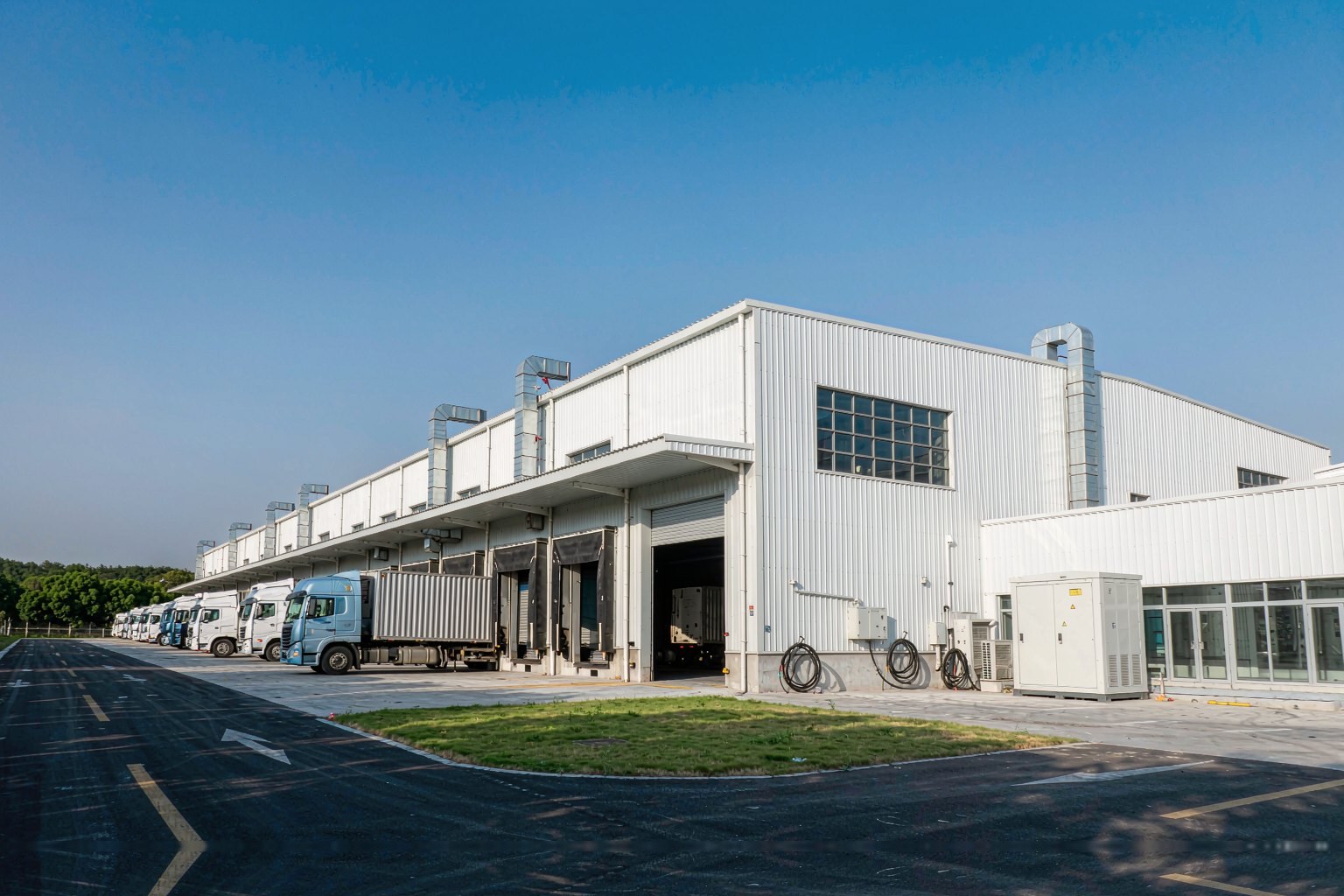
In most industrial sites, the cost of a power outage is measured in lost production hours. In a cold store, it is measured in product. Refrigeration is a continuous process with no natural pause: when compressors stop, the temperature of the stored load begins to move, and what follows is a disposition decision about inventory rather than a restart procedure.
That difference shapes how these sites should evaluate battery storage. Refrigeration loads are strongly seasonal, sharply peaked in summer, dominated by compressor behaviour, and often paired with large rooftop areas that suit PV. A battery at a cold store is usually doing three jobs at once, and the design has to be explicit about which one takes priority.
This article covers the load characteristics of refrigeration, the compressor starting problem, how to think about outage exposure without exaggerating it, the three roles storage can play, what changes when equipment operates near or below freezing, and the hygiene, fire and siting requirements specific to food facilities.
Refrigeration load is seasonal and cyclical
Refrigeration load tracks ambient temperature, because condenser performance depends on the temperature difference the plant works against. A cold store at −20°C in a 35°C climate fights a far larger gradient than the same store at 15°C. Three consequences follow.
Summer peaks align with tariff peaks. The highest refrigeration load occurs on hot afternoons, exactly when many C&I tariffs apply peak rates and record monthly demand. Load shape and tariff shape point the same way, which is not true of every industrial segment.
The daily profile is driven by operations. Defrost cycles, door openings, dock activity and product intake at ambient temperature superimpose peaks on the base load. Pull-down after a delivery is one of the largest single contributors.
Thermal mass provides a small, real buffer. Product and envelope hold temperature after compressors stop, and some operators use controlled pre-cooling. That measure interacts with storage: both shift load, and unless coordinated by the same controller they can work against each other or compound a peak later in the day.
Compressor starting and demand spikes
Refrigeration plants present a distinctive demand problem: motors are large, they start under load, and several of them may restart together.
Direct-on-line compressor starts draw multiples of running current for a short period. When a defrost cycle ends and evaporator fans, compressors and pumps restart in sequence, or when a plant recovers from a brief disturbance, that inrush can produce a demand spike that sets the monthly maximum. A five-minute spike can determine a charge applied across the whole month.
The cheaper measures should be considered first, because they are genuinely effective: soft starters or variable speed drives on compressors, staggered restart logic after defrost, and defrost scheduling that avoids coinciding with the tariff peak window. Storage should not be used to hide a control problem.
Where storage is the right answer, it works differently from a starter: it caps measured site demand regardless of cause. One specification detail matters here. Before modelling any demand-charge benefit, confirm how the utility measures demand — whether it is a 15- or 30-minute average, and whether it is a sliding window or a fixed block. A very short spike may not register in an averaged interval, and a model built on the wrong assumption will overstate the benefit.
Outage exposure, measured in product
A loss of refrigeration does not spoil product instantly. The envelope and the thermal mass of the stored load provide a buffer, and how long it lasts depends on insulation condition, fill level, product type, ambient temperature and whether doors are being opened. What matters for design is the relationship between outage duration and consequence, not a generic figure.
| Exposure | What determines it | Relevant mitigation |
|---|---|---|
| Temperature rise rate | Insulation, envelope condition, fill level, ambient | Maintenance and envelope upgrades first |
| Time to product limit | Product type, starting temperature, door openings | Defined autonomy target for backup |
| Recovery after restoration | Pull-down capacity, compressor sizing | Staggered restart; storage support during pull-down |
| Recorded evidence | Temperature logging and retention | Continuous monitoring with alarms |
| Downstream cost | Cleanup, disposal, rework, claims, audit findings | Documented contingency procedure |
The natural unit for this exposure is a batch, a room or a truckload — not a monetary figure, which varies too widely between products and markets to be useful in a technical document. What a plant can quantify for itself is how many hours of autonomy would prevent the loss, and what happens at each hour beyond that.
Two practical points follow. Backup is not automatic on a grid-tied system: it requires islanding capability and a protected bus carrying the critical refrigeration loads, designed in from the start. And after restoration, pull-down of a warmed store is itself a large load — a spike that storage or staggered restart should cover.
Three roles, and the priority between them
A cold-chain battery is usually asked to do three things:
- Peak shaving and demand limiting, especially on summer afternoons when refrigeration load and tariff peak coincide.
- Backup and ride-through for the critical refrigeration bus, sized to a stated autonomy.
- Higher PV self-consumption, since cold stores typically have large, unshaded flat roofs and significant daytime load — but refrigeration also runs overnight, when PV produces nothing.
These roles compete for the same stored energy. A reserve held for backup is energy unavailable for arbitrage; a battery discharged into the afternoon peak may not be full when an outage arrives. The EMS therefore needs a stated priority policy, and the policy is a business decision: autonomy hours first, then whatever remains can be cycled. A system without that stated policy will appear to work until the day it does not.
Illustrative backup sizing
The table below is illustrative only. Autonomy targets, refrigeration load and usable energy must come from your own plant data; usable capacity depends on depth of discharge, temperature, discharge rate and battery age.
| Critical refrigeration load | Autonomy target | Energy required (illustrative) | Suggested configuration |
|---|---|---|---|
| 40 kW | 4 h | ≈ 160 kWh | 1 × BR-261 (≈ 211 kWh usable) |
| 80 kW | 4 h | ≈ 320 kWh | 2 × BR-261 (≈ 423 kWh usable) |
| 120 kW | 2 h | ≈ 240 kWh | 2 × BR-261 (≈ 423 kWh usable) |
| 250 kW | 2 h | ≈ 500 kWh | 3 × BR-261 (≈ 634 kWh usable) |
Usable energy per cabinet is shown at 0.90 depth of discharge and approximately 90% AC round-trip efficiency. Two checks belong alongside the table. First, motor starting: the PCS has to cover compressor and fan inrush, not only running load, so a motor starting study and confirmation of the converter's overload capability are required — in some plants a soft starter or variable speed drive is the more economical way to solve that part. Second, islanding: the configuration only delivers autonomy if the system is specified with islanding capability and the loads are on a protected bus.
For larger distribution parks and centralised cold stores, the 5.01 MWh liquid-cooled container system, rated at 0.5C, provides roughly 2.5 MW in a single 6,058 × 2,438 × 2,896 mm footprint, and the BR-261 supports up to 8 units in parallel for staged expansion.
Operating in and around low temperatures
Cold-chain sites are the segment where temperature limits bite hardest, because the process creates the cold environment.
Charging is the binding constraint. The BR-261 is specified for operation from −20°C to 55°C, with charging limited to 0–55°C and discharge across the full range. A cabinet placed inside a −20°C cold room cannot be charged there. It must be sited outdoors, in a heated or ventilated space, or operated under its low-temperature heating function — which consumes energy that belongs in the model, and whose behaviour should be confirmed with the supplier rather than assumed.
Heat is also a summer issue. The same ambient conditions that drive the refrigeration peak are the conditions in which the battery works hardest. The BR-261 liquid-cooled system is specified at maximum cell temperature ≤ 38°C at full power with cell temperature difference within 3°C; temperature uniformity is what governs long-term capacity retention under daily cycling.
Condensation and humidity matter. Equipment moved between temperature extremes, or sited where cold-room doors discharge humid air, needs its specified humidity range respected. The 5.01 MWh container is specified for humidity up to 95% RH, non-condensing, and for altitudes up to 3,000 m, which is relevant for highland processing sites.
Where the cabinet sits relative to cold rooms is worth engineering attention: thermal bridges through the slab, door icing from drainage, and service access that does not require entering a controlled-temperature area.
Hygiene, fire and outdoor installation requirements
Food facilities impose siting constraints that other industrial sites do not:
- Hygiene zoning. Raw and ready-to-eat areas are separated for a reason. Storage equipment should not obstruct hygiene routes, pest control access or drainage, and should not be placed where it cannot be kept clean.
- Washdown and corrosion. Cleaning agents and salt are aggressive. IP55 with C4 corrosion protection is a reasonable baseline; sites using strong cleaning chemicals, or coastal seafood facilities, should consider C5.
- Clearances. Service access, ventilation and fire separation distances have to be maintained. Confirm local fire authority requirements before fixing the layout, since separation distances vary by jurisdiction.
- Fire protection. Specify more than one level: pack-level and system-level aerosol suppression on the cabinet platform, backed by 50 mm rock wool insulation with a one-hour fire resistance rating and an explosion-proof cabinet design. The container system adds temperature and smoke sensing, combustible gas detection, explosion venting, gas suppression and water sprinkler.
- Ammonia plants. Where refrigeration uses ammonia, coordinate siting with the machinery room safety zone and the site's hazardous area classification. This is a specific engineering review, not a formality.
- Electrical compatibility. A 380/400 Vac, 50/60 Hz, three-phase five-wire connection with THDi ≤ 3% and a power factor range of −0.99 to +0.99 protects both the utility connection and the plant's own motors and drives. Class II AC lightning protection with fault alarming and residual current detection are standard requirements.
- Noise. Where a container is placed near offices or residential neighbours, the 5.01 MWh system is specified at ≤ 80 dB(A) at 1 m, with a 75 dB(A) option.
FAQ
How long can storage keep a cold room running during an outage?
For as long as it is designed to, which is a decision rather than a specification. Autonomy is usable energy divided by the critical refrigeration load, and both must be stated: which loads are on the protected bus, at what load, for how many hours, and under what state-of-charge policy. Two sites of the same size can legitimately choose different targets.
Can the battery be installed inside the cold store?
Not normally. Charging is limited to 0–55°C on the BR-261, so a cabinet in a freezing environment cannot be charged there. The options are outdoor siting, a heated or ventilated room, or operation under the low-temperature heating function — with the heating energy accounted for in the design.
Does backup require a separate distribution board?
Yes, in practice. Backup requires islanding capability and a protected bus carrying only the critical refrigeration loads. That has to be designed in from the start; it is expensive to add later, and a grid-tied peak-shaving system does not provide backup by default.
Can storage handle compressor starting current?
It can contribute, but it should not be assumed. A motor starting study plus confirmation of the converter's overload capability is the correct approach, and in many plants a soft starter or variable speed drive addresses the inrush more economically. The two are often combined.
Will it work alongside our rooftop PV?
Yes, and the fit is often good: cold stores have large roofs and daytime cooling load. Refrigeration also runs overnight, so storage carries PV energy into the night. The EMS needs a stated priority between PV self-consumption, peak shaving and the backup reserve.
What to do next
For a cold-chain site, the useful first step is to separate the three jobs and write them down: how many hours of autonomy you need and on which loads; what your summer demand peak looks like against the tariff window; and how much PV the roof could carry. Those answers determine the configuration more reliably than any rule of thumb.
BR SOLAR's BR-261 100 kW / 261 kWh liquid-cooled cabinet integrates EMS, PCS and BMS in an IP55 enclosure with LFP cells, liquid cooling, low-temperature heating and multi-level fire protection, and supports up to 8 units in parallel. For larger cold stores the 5.01 MWh container system covers utility-scale duty. Share your load profile, autonomy target and site constraints, and the review can start there.






