

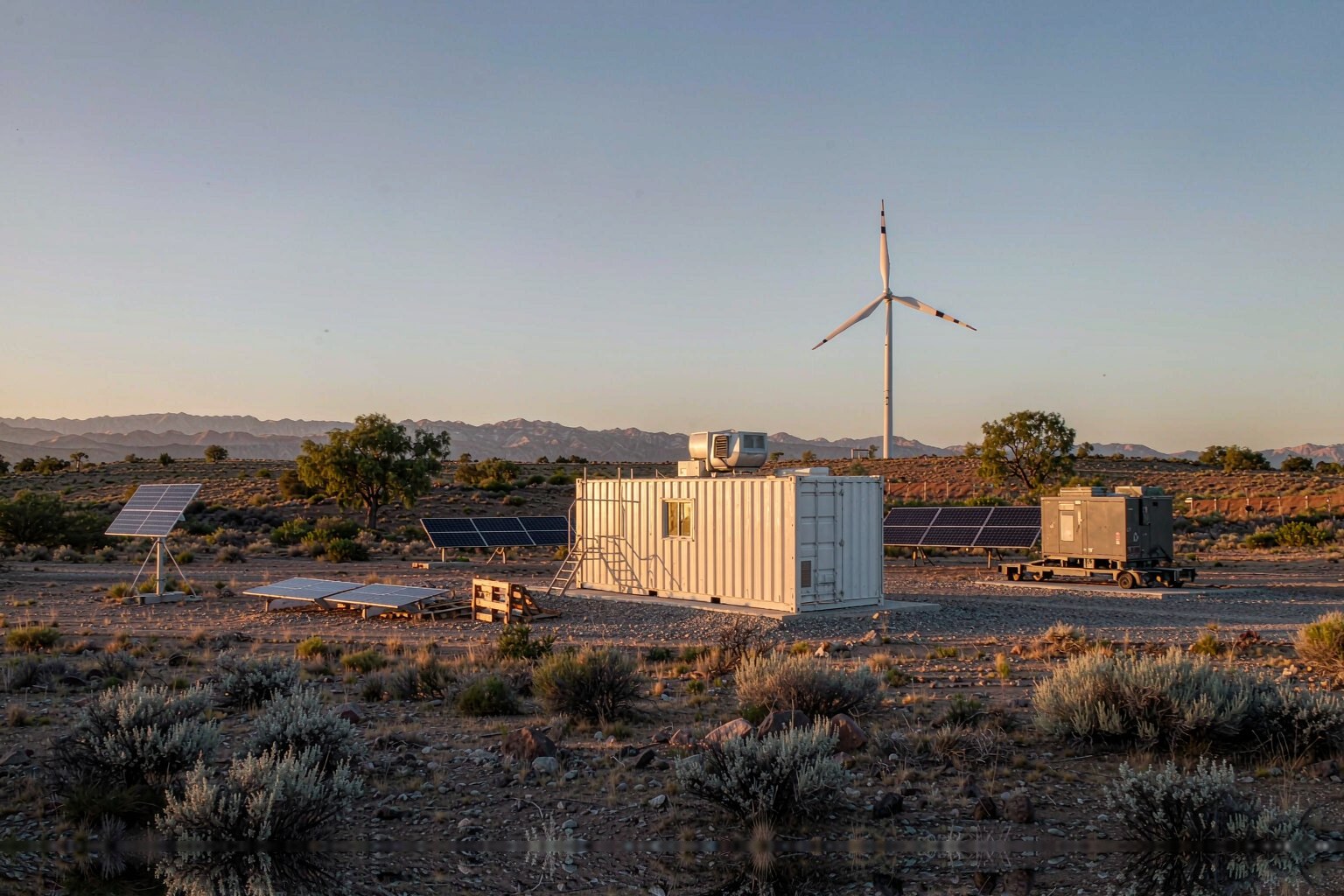
A mine, an oilfield gathering station, a remote construction camp and an island resort share one thing a city factory does not: the grid is either absent, or present in name only. Power may arrive on a weak feeder with poor voltage regulation, or by drum and tanker. The default answer has been the diesel genset — dispatchable, transportable, and running within weeks of a site being staked out.
What has changed is the arithmetic around running one as the primary source. Fuel logistics are fragile, maintenance windows are expensive to reach, and every hour the engine turns is an hour of wear paid for whether or not the site is productive. Used properly, storage changes the generator's job from "run continuously" to "run when nothing else can".
This article is for owners, EPC contractors and procurement teams evaluating that shift. It avoids payback promises: on remote sites the answer depends more on the fuel delivery contract and operating calendar than on any datasheet. What it covers is the design logic, starting with the true cost of a diesel kilowatt-hour.
What a remote kilowatt-hour actually costs
The most common mistake in remote-site evaluation is comparing the cost of solar generation against the cost of diesel fuel. Those are not comparable numbers. The relevant comparison is against the full cost of producing a kilowatt-hour on site:
- Fuel burned — the line everyone tracks, and usually the largest at reasonable loading.
- Fuel delivered — transport, handling, storage losses and the inventory cost of holding weeks of stock, which at remote locations can rival the fuel itself.
- Maintenance and overhaul — engine hours drive service intervals, injector work and eventually a mid-life overhaul.
- Capital recovery and standby cost — the generating capacity has to exist regardless of how often it runs.
A simplified assessment, using illustrative figures only to show the shape of the calculation:
| Cost element | Illustrative basis | Indicative contribution |
|---|---|---|
| Fuel consumption | 0.28 L/kWh specific fuel consumption at good loading, fuel at $1.10/L delivered to site | ≈ $0.31/kWh |
| Consumables and routine service | Oil, filters, labour, small parts, apportioned per kWh over the service interval | ≈ $0.05/kWh |
| Major overhaul reserve | Top-end and mid-life overhaul accumulated into an hourly reserve | ≈ $0.04/kWh |
| Low-load penalty | Operation below roughly 30–40% rated load raises specific consumption and causes wet stacking | Adds materially; highly site-specific |
| Illustrative total | Excludes capital recovery and fuel logistics losses | ≈ $0.40/kWh and upward |
Two things follow. First, delivered cost on a remote site sits in a different band from industrial grid tariffs — which is why remote sites often reach a viable storage case where a feed-connected plant in the same country would not. Second, much of that cost scales with engine hours rather than energy delivered, so a strategy that reduces run hours captures more value than one that merely improves fuel per hour. That is the design principle behind everything below.
The energy management logic: attacking engine hours
A solar-storage-diesel microgrid is not a generator with panels bolted on. The value sits in four controller decisions.
Cutting run hours, not just litres
The simplest control mode shuts the genset down whenever battery state of charge and PV forecast indicate the two together can carry the load. Where daytime solar is strong, this removes the middle of the day from the generator's calendar. Because wear accrues per running hour, removing eight hours a day removes roughly a third of the engine's annual service and overhaul burden, even in months where fuel savings are modest.
This mode changes maintenance planning too: engines that start and stop often need attention to start reliability, coolant conditioning and battery health. It also keeps generators out of low-load operation, where below roughly a third of rated load specific consumption climbs and unburned fuel fouls injectors and shortens overhaul intervals.
Letting storage absorb transient and impact loads
Mining and processing loads are not smooth. Crushers, conveyors, hoists, mills, drill rigs and large pumps produce starting currents and step changes several times their running power. Traditionally the fleet is sized for the worst transient, carrying capacity that sits idle most of the time, while every transient causes a voltage and frequency excursion.
A battery inverter responds in milliseconds, an engine in seconds. With storage carrying the transient, the fleet can be sized closer to average load, excursions shrink — protecting drives and instrumentation — and fewer engines run in parallel at peak.
Managing the solar ramp
Cloud passing over a large PV array can remove most of its output within tens of seconds. Without storage, the generator must be spinning and loaded enough to pick up that step, so it cannot be shut down during sunny hours — negating most of the benefit. Enough battery power lets the controller keep the genset stopped and cover the ramp.
Renewable penetration: the honest trade-off
"Renewable penetration" is the share of site energy met by solar and storage rather than fuel. Higher penetration means less diesel, but each increment costs disproportionately more: every extra megawatt-hour from the sun needs storage to make it dispatchable at night or through cloud.
There is also a stability dimension. In a pure off-grid design the system must always retain enough instantaneous power to cover the largest credible load step plus the largest credible generation loss, and that reserve cannot be sold off for fuel savings. Push instantaneous penetration too high and the system saves fuel on an average day but trips on a bad one. Most designs therefore land on a deliberate compromise: high energy penetration over the year, with a firm reserve held at all times, pushed further where a weak grid connection can act as a backstop.
Sizing for autonomy: daily cycling versus multi-day self-sufficiency
Two different questions drive two different designs, and they are frequently confused.
Daily cycling means storage covers the night and early-morning peak while solar recharges it each day: a shallow-autonomy design, usually correct where the climate is reliable and fuel arrives within days.
Multi-day self-sufficiency means storage carries critical load through several consecutive low-solar days — a monsoon week, a dust storm, a high-latitude winter. It is a resilience specification: every extra day multiplies capacity, and cost per avoided litre rises sharply after the first.
The table below is illustrative only, based on a hypothetical constant 500 kW site load, and deliberately ignores depth of discharge, round-trip losses, temperature derating and reserve margins, all of which raise the real requirement:
| Requirement | Energy to be covered | Number of 5.01 MWh units (rounded up) |
|---|---|---|
| Night block only (12 h at 500 kW) | 6,000 kWh | 2 |
| One full day of site load | 12,000 kWh | 3 |
| Two days of autonomy | 24,000 kWh | 5 |
| Three days of autonomy | 36,000 kWh | 8 |
The point is not the container count. Autonomy decisions dominate cost, and they should be made on the critical load that must survive an interruption, not the total connected load. Separating the two is usually the highest-value exercise before a quotation request.
Site conditions that decide the specification
Remote sites punish equipment designed for a suburban rooftop. Four factors routinely change the specification.
Temperature extremes. A wide envelope matters more than peak performance. −30 to 50°C covers high-altitude winters and desert summers without derating assumptions in the proposal, while the 95% RH non-condensing limit matters where condensation is a persistent failure cause.
Altitude. Thin air reduces the cooling capacity of air-based thermal management and can derate power electronics. A specification validated to 3,000 m covers most mining regions; above that, ask about derating explicitly.
Dust and salt. IP55 handles dust and water jets, covering most mining and desert sites. Coastal terminals, islands and offshore bases are the exception: salt-laden air accelerates corrosion, and C5 (above standard C4) is normally the correct ask.
Noise. Workers' camps, island resorts and sites near communities have acoustic limits often overlooked until after installation. ≤80 dB(A) at 1 m, or 75 dB(A) with the optional package, must be checked against the local limit and the distance to the nearest structure.
Grid connection, island transition and black start
Many remote sites are not truly off-grid — they sit at the end of a weak feeder that fails regularly, which adds a third category of requirement.
Seamless or near-seamless transition. When the feeder fails the site must separate and continue on local generation. With a crusher or hoist running, a multi-second transfer interruption can be as damaging as a full outage, so ride-through depends on the control architecture and on whether critical loads sit on a protected bus.
Black start. After a total shutdown, storage is a natural starting source: no fuel logistics, no warm-up, no auxiliary supply. It energises the bus, sets reference voltage and frequency, then starts the generators. This must be designed in — it is not automatic.
Weak-grid behaviour. A storage inverter at a controllable power factor supports voltage on a thin feeder rather than aggravating it, which is why power factor range and harmonic performance matter in remote applications too.
The 5.01 MWh container as a building block
For larger camps, processing plants and island systems, a containerised lithium iron phosphate unit offers a module that scales by quantity rather than redesign.
The 5.01 MWh liquid-cooled container uses 3.2 V / 314 Ah LFP cells in a 1P416S × 12 arrangement, giving a nominal 1,331.2 V system with an operating window of 1,164.8 to 1,497.6 V. Its 0.5C maximum charge and discharge rate corresponds to roughly 2.5 MW of instantaneous power, though AC output depends on the power conversion specified alongside.
Liquid cooling supports sustained cycling in high ambient temperature and, unlike forced air, does not pull dusty outside air through the enclosure — an advantage in open-pit and desert sites. The unit is rated for −30 to 50°C, ≤95% RH non-condensing and 3,000 m, covering most remote industrial geographies without site-specific derating studies, and carries IP55 with C4, with C5 available for marine exposure. Fire protection is layered: temperature sensing, smoke and combustible gas detection, explosion venting, gas suppression and water spray — which matters where emergency response may be hours away. Ethernet, CAN and RS485 allow integration with a microgrid controller or SCADA. Physically it is 6,058 × 2,438 × 2,896 mm and approximately 42,000 kg; transport, crane availability and foundations are often the schedule-critical items.
For smaller satellite facilities — a borehole pumping station, a repeater, an exploration camp — the container is oversized. The BR-261 platform, supporting up to 8 units in parallel, suits distributed sub-sites on the same controller, and its −20 to 55°C discharge window with low-temperature heating covers sub-sites where the container envelope is not the binding constraint.
FAQ
Can storage and solar replace diesel generators entirely?
In some island and high-insolation sites with modest overnight load, yes. In most mining and continuous-process applications, generators remain but run far fewer hours, start less often, and can be specified closer to average load. The value is avoided engine hours and fuel deliveries, not removing the fleet.
How many days of autonomy do we actually need?
It depends on how often fuel supply can be interrupted, and what an interruption costs. Sites with reliable weekly deliveries often optimise for one day or less; exposed sites may specify two to three days for critical load only.
Does the system still work during a sandstorm or a heavy overcast week?
Yes, but the design has to account for it. The controller restarts the generators when reserve reaches its floor. Whether that floor is high enough, and whether the fleet carries full load through the worst credible weather period, is a sizing input rather than an operational surprise.
Can the battery black-start the site after a total shutdown?
Yes, if black-start capability is specified. If it matters to your operating plan, state it in the specification rather than assuming it is included.
Do we need C5 corrosion protection?
If the site is coastal, on an island, or near a salt-producing process, C5 is normally appropriate. For inland mining, desert and most industrial environments, standard C4 is generally adequate.
Discussing a specific site
Remote microgrids are among the least standard products in the storage market. Two sites with identical loads produce different designs once fuel logistics, access, altitude, seasonal weather and critical-load definition are considered, so a generic proposal is rarely useful.
A productive first conversation needs only a few inputs: interval load data or a load list with diversity assumptions; the current generator fleet and its fuel consumption; fuel delivery terms and worst-case resupply time; the critical load that must survive an interruption; and the site's altitude, temperature extremes and access. With those, a configuration built around the 5.01 MWh liquid-cooled container can be sized against real constraints rather than averages.






