


ESS Air Cooling vs Liquid Cooling: Choosing the Right Thermal Strategy for Energy Storage Systems
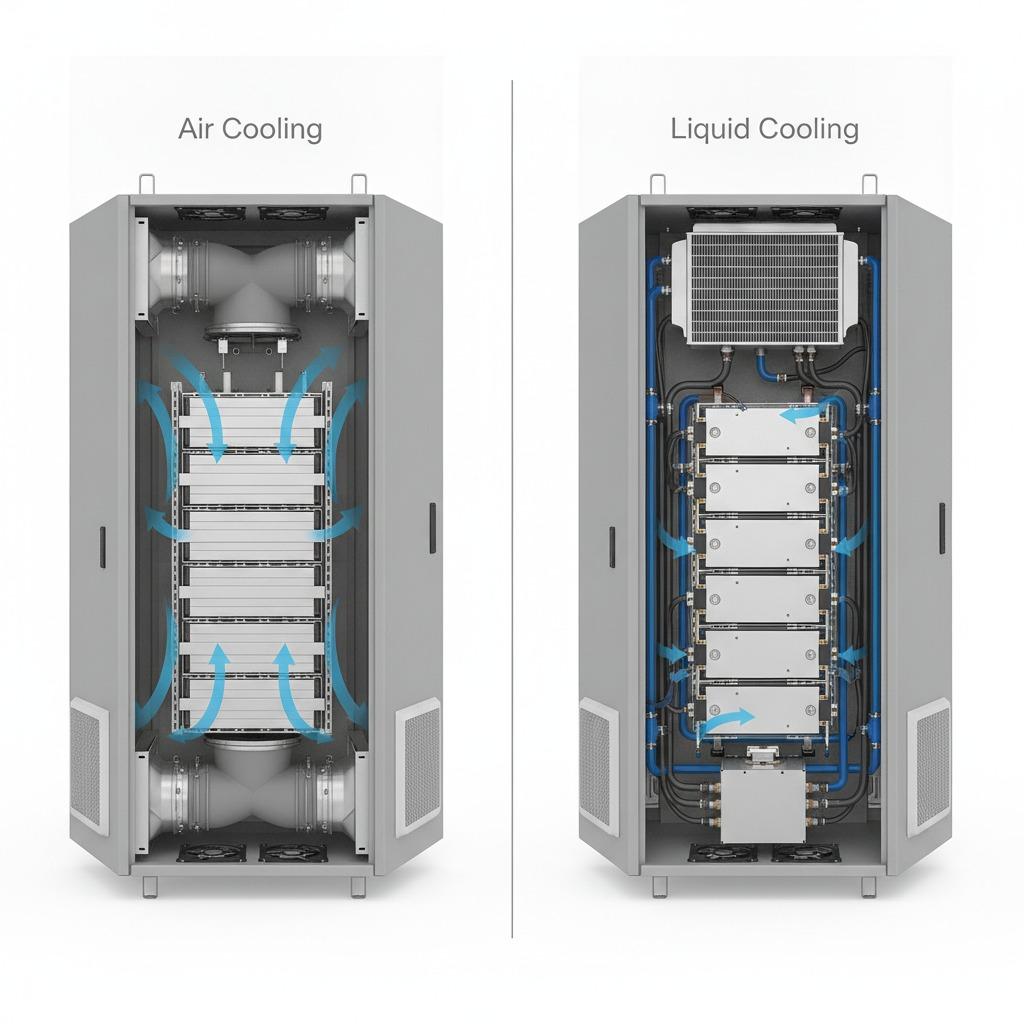
When buyers compare ESS air cooling vs liquid cooling, the real question is usually not which method is technically more advanced. It is which thermal architecture makes sense for a specific energy storage system, site condition, budget, maintenance plan, and risk profile. For engineers and sourcing teams, that decision can affect battery life, system footprint, noise, serviceability, and operating stability far more than it first appears.
Energy storage systems run on chemistry, electronics, and repetition. Cells heat up during charge and discharge cycles, and temperature spread across modules can quietly erode performance if it is not managed well. A cooling system is not just an accessory bolted to the cabinet. It is part of the system’s reliability story, especially in containerized storage, cabinet-style ESS, and installations that must operate through seasonal temperature swings. That is why the comparison between air and liquid cooling deserves more than a quick pros-and-cons list.
What the buyer is really deciding
At a practical level, the choice comes down to how much heat needs to be moved, how uniformly it must be removed, and how much complexity the project can tolerate. Air cooling uses fans and ducting to move conditioned air through the enclosure and across battery modules or electronic components. Liquid cooling uses a fluid circuit, typically with a coolant loop and a heat exchanger, to absorb and carry away heat more efficiently.
That sounds straightforward, but the choice affects nearly every downstream decision: enclosure design, maintenance intervals, sealing strategy, acoustic requirements, site dust levels, freeze protection, leak risk, and even shipping considerations. A large utility-scale project in a hot climate may lean one way. A commercial indoor system with easier access for service may lean another. There is no universal winner, and anyone selling one as such is probably simplifying too much.
Air cooling in ESS: where it still makes sense
Air cooling remains common because it is familiar, relatively simple, and easier to maintain in many cases. Fans move air through the system, and the design usually relies on filtered airflow paths, internal ducting, heat sinks, and cabinet-level ventilation. For smaller systems or installations with moderate thermal loads, this approach can be perfectly adequate.
Typical strengths of air cooling
Air-cooled ESS designs often have fewer fluid-related components, which can reduce complexity and simplify service. That matters in markets where technicians are already trained on HVAC-style maintenance and where spare parts availability is important. Air systems also tend to be easier to inspect visually. A blocked filter, failed fan, or restricted air path is often obvious during routine checks.
There is also a packaging advantage. In some applications, especially where cost and simplicity matter more than extreme thermal density, air cooling can support a cleaner procurement decision. Fewer parts can mean fewer failure modes. That is not a guarantee of better uptime, but it does reduce the number of things that can go wrong.
Where air cooling starts to struggle
The main limitation is thermal transfer efficiency. Air does not move heat as effectively as liquid, so the system often needs more airflow, more internal space, and tighter attention to hot spots. In large battery racks, the temperature difference between the coolest and warmest cells can become harder to control. That spread matters because uneven cell temperatures can accelerate aging and reduce usable capacity over time.
Air cooling is also sensitive to the environment around the ESS. Dust, salt air, humidity, and clogged filters all raise maintenance demands. In hot climates, the system may work harder just to keep up, and fans alone may not be enough during sustained high-load operation. There is a practical limit to how much heat you can move with air before the footprint and power draw become less attractive.
Liquid cooling in ESS: why it is gaining ground
Liquid cooling is increasingly favored in higher-density energy storage applications because fluids can transport heat much more efficiently than air. That makes it easier to control module temperature and reduce hotspots. In systems where cells are packed tightly or where performance is sensitive to temperature uniformity, liquid cooling can offer a real engineering advantage.
What liquid cooling does well
Liquid cooling is often chosen when thermal loads are high, enclosure density is tight, or ambient conditions are harsh. A well-designed coolant loop can remove heat from battery modules more consistently than forced-air systems, which may help preserve usable capacity and support longer service life. It can also reduce the amount of internal air movement needed, which may help with noise and dust ingress concerns.
Another practical benefit is control. Liquid systems can be designed for precise thermal regulation, and that helps when the ESS must operate across varying charge and discharge profiles. In a project where energy throughput is heavy and the system sees frequent cycling, more stable temperatures can be worth the added engineering complexity.
What to watch closely
Liquid cooling is not free of tradeoffs. It introduces pumps, fluid circuits, seals, and potential leak points. That means procurement teams need to ask more pointed questions about maintenance access, fluid compatibility, monitoring, and fail-safe behavior. A leak in an energy storage environment is not something to treat casually, even when the coolant is nonconductive or the system is well isolated. The risk profile is simply different.
Liquid cooling also adds design and integration complexity. The system may require tighter quality control, more careful commissioning, and a service team that understands both electrical and fluid-side components. For some buyers, especially those managing many distributed sites, that extra complexity can be a burden if local maintenance capacity is limited.
ESS air cooling vs liquid cooling: a quick buyer’s comparison
Air cooling is generally easier to understand, easier to maintain, and often lower in upfront complexity. It fits smaller or moderate-density systems, milder environments, and projects where service teams want straightforward inspection routines.
Liquid cooling is generally better suited to higher-density storage, more demanding thermal conditions, and applications where temperature consistency is central to performance. It can support more compact packaging and stronger thermal control, but it asks for more disciplined maintenance and a stronger integration plan.
If you need a rough decision rule, think this way: when thermal load is manageable and service simplicity matters most, air cooling often stays in the running. When heat density rises and temperature uniformity becomes a design priority, liquid cooling usually earns a closer look.
Selection criteria that matter in real projects
1. Site environment
Dusty outdoor sites, coastal locations, and high-ambient-temperature regions all raise the stakes. Air cooling can work in these environments, but the maintenance burden increases. Liquid cooling may offer better thermal stability, though it brings its own mechanical requirements. Site conditions should be treated as a first-order design input, not a footnote.
2. System power density
The more energy you pack into a given footprint, the more difficult thermal management becomes. High-density ESS platforms often favor liquid cooling because air has trouble keeping temperature spread under control without larger ducts, higher airflow, or additional internal space.
3. Maintenance capability
Procurement teams should ask who will actually service the system after commissioning. If the answer is a local contractor with limited specialized training, air cooling may be easier to support. If the project owner already manages more complex mechanical systems, liquid cooling may be acceptable and even preferable.
4. Noise and enclosure constraints
Fan-heavy air-cooled systems can be noisy, especially in installations where airflow demand is high. That may not matter in a remote utility yard, but it can matter in commercial or mixed-use settings. Liquid cooling can help reduce dependence on aggressive airflow, though pumps and control equipment still produce some noise.
Common mistakes buyers make
One common mistake is comparing only upfront cost. Air cooling may appear cheaper at the purchase stage, but if the site is hot, dusty, and heavily cycled, the savings can narrow quickly once maintenance and performance loss are accounted for. The reverse can also happen: a liquid-cooled system may look attractive on paper but be overengineered for a small installation that never needs that level of thermal control.
Another mistake is treating all ESS applications as the same. A telecom backup system, a commercial peak-shaving cabinet, and a utility-scale container do not have identical thermal needs. Neither cooling method should be selected by habit. The battery chemistry, duty cycle, enclosure type, and climate all matter.
Buyers also sometimes underestimate service access. If a system requires specialized fluid checks, leak inspection, or more involved commissioning, that needs to be reflected in the operating plan. A neat spec sheet is not enough. Field reality has a way of correcting optimism.
Practical guidance for engineers and sourcing teams
If you are building a comparison matrix, start with temperature uniformity, not just maximum cooling capacity. Then weigh maintenance labor, environmental exposure, acoustic limits, and footprint. After that, look at total system architecture: does the supplier offer a design that integrates the cooling method cleanly, or is the thermal package clearly an afterthought?
It is also wise to ask how the system behaves under partial failure. What happens if a fan degrades? What happens if a pump loses efficiency? What alarms are available, and how visible are they to operators? In ESS, graceful degradation matters. The best cooling approach is not merely the one with the highest nominal performance; it is the one that remains manageable when something inevitably drifts out of spec.
FAQ: short answers buyers usually need
Is liquid cooling always better than air cooling?
No. It is usually better for higher-density or more demanding systems, but that does not make it the right choice for every project.
Is air cooling outdated?
Not at all. Air cooling still fits many ESS applications, especially where heat loads are moderate and service simplicity matters.
Which system is easier to maintain?
Air cooling is often easier to maintain in the field, though liquid cooling can be manageable if the operator has the right training and procedures.
What should I ask suppliers first?
Ask about thermal performance at your expected ambient conditions, service intervals, failure behavior, and how the cooling design supports battery temperature uniformity over time.
What to do next
If you are evaluating ESS air cooling vs liquid cooling for a current project, start with the load profile and the site environment, then pressure-test the maintenance model. That sequence usually exposes the real answer faster than any brochure comparison. For procurement teams, the best next step is to request a thermal design summary tied to your actual operating conditions, not a generic spec sheet.
The right cooling method should make the system easier to operate, not harder to explain. If a supplier cannot show how its approach fits your site, your duty cycle, and your service plan, keep looking.





