


LiFePO4 batterij elektrochemische kenmerken: what engineers should actually look at
For buyers comparing battery chemistries, the phrase
LiFePO4 batterij elektrochemische kenmerken
can sound more academic than practical. It is not. Those electrochemical traits shape how the cell charges, how safely it behaves under stress, how long it lasts in a real system, and whether it fits the duty cycle your product actually needs. For sourcing managers and product teams, the point is less about chemistry trivia and more about making a decision that will not become a field failure six months after launch.
LiFePO4, or lithium iron phosphate, is widely used where stability and cycle life matter more than squeezing every last watt-hour into a compact enclosure. That makes it especially relevant in energy storage, industrial backup power, mobility equipment, and many embedded systems that see repeated charging rather than long idle periods. The chemistry is not a universal answer, though. It has clear strengths and a few tradeoffs that are easy to miss if you only compare nominal voltage and capacity.
Why the electrochemistry matters in purchasing decisions
Battery selection often starts with a spreadsheet: voltage, capacity, footprint, and cost. That is useful, but incomplete. The electrochemical behavior of a cell determines how those numbers hold up under load, temperature variation, and aging.
A battery that looks attractive on paper can behave differently once it is asked to deliver high current, sit at partial state of charge for long periods, or operate in a warm enclosure. In practice, the chemistry affects:
How stable the voltage remains during discharge
How quickly the cell degrades after repeated cycles
How sensitive the pack is to abuse, overcharge, and heat
How much usable capacity remains across the operating range
How much system-level protection the pack and BMS must provide
These are not abstract concerns. They influence warranty risk, maintenance schedules, enclosure design, and even shipping decisions.
Core electrochemical characteristics of LiFePO4
Flat discharge profile
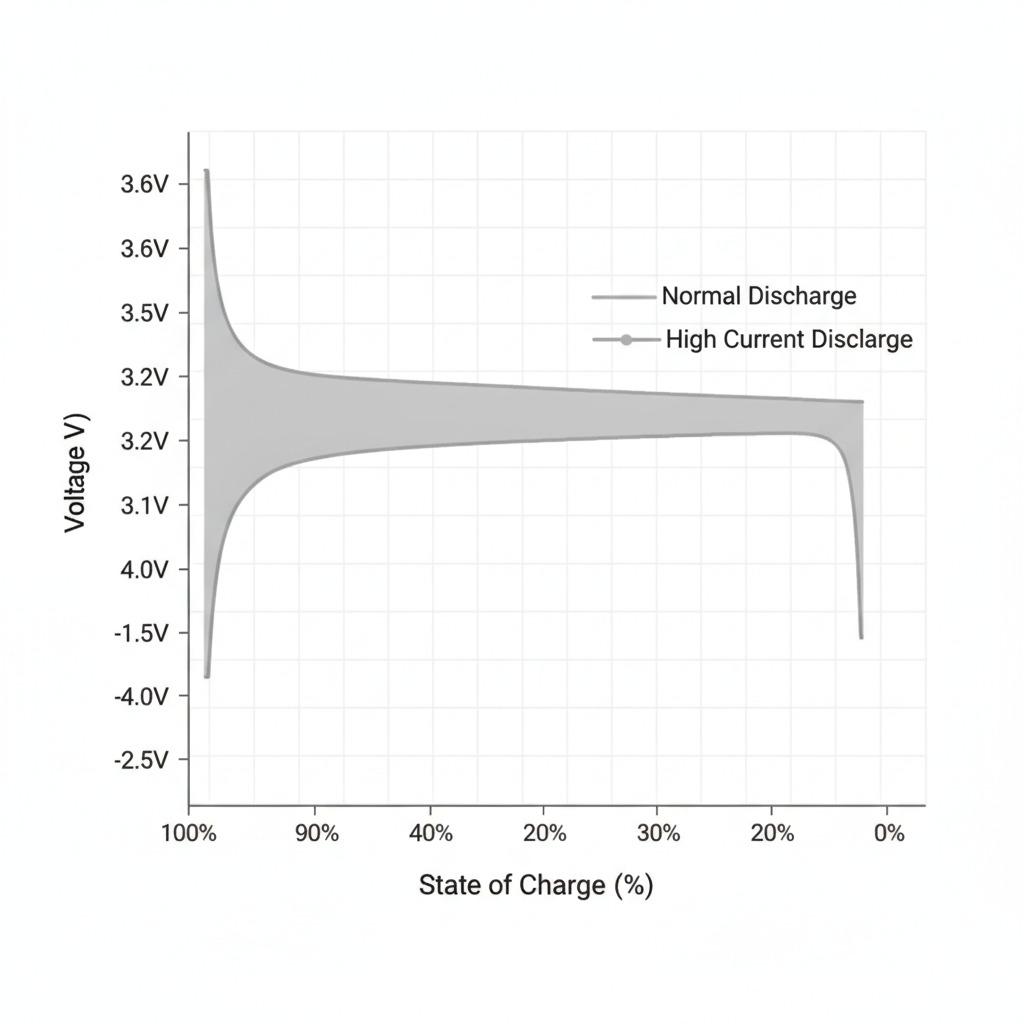
One of the most familiar traits of LiFePO4 chemistry is its relatively flat discharge curve. In simple terms, the voltage stays fairly steady for much of the discharge cycle before dropping more noticeably near the end. For equipment designers, that can be helpful because devices see more consistent operating voltage over most of the usable range.
The same trait can also complicate state-of-charge estimation. Voltage alone is often a poor indicator of remaining charge, especially when the pack is at rest or under light load. Systems typically need a well-tuned battery management system, current integration, or a more sophisticated estimation method rather than relying on open-circuit voltage as a shortcut.
Stable phosphate cathode structure
The lithium iron phosphate cathode has a structure that is generally more stable than some other lithium-ion chemistries. That stability is one reason LiFePO4 is often chosen for applications where safety and predictable behavior are central concerns.
At a practical level, the chemistry tends to be more forgiving under heat and less prone to thermal runaway than certain higher-energy-density alternatives. That does not mean it is invulnerable, and it should never be treated casually, but it does give engineers more room when designing for robust service rather than maximum energy density.
Long cycle life under managed conditions
LiFePO4 is frequently selected for systems that will be charged and discharged many times. Its cycle life can be strong when the pack is operated within sensible voltage, temperature, and current limits. The exact lifespan depends on cell quality, pack design, depth of discharge, and thermal management, so it is wise not to assume all LiFePO4 packs perform equally.
The useful takeaway is that this chemistry generally holds up well in daily cycling applications. That makes it attractive for storage systems, fleet equipment, and industrial devices where replacement labor is expensive even when the cells themselves are not.
Lower nominal voltage per cell
LiFePO4 cells have a lower nominal voltage than many other lithium-ion chemistries. That has design consequences. Pack configurations may need more cells in series to reach a target system voltage, and legacy equipment built around older lithium-ion assumptions may not be compatible without redesign.
This is one of those details that appears minor until the integration phase. A procurement team may see a battery with the right capacity, but the engineering team still has to confirm charger compatibility, BMS limits, inverter settings, and cut-off behavior.
Key strengths and tradeoffs at a glance
If you need a quick buyer-level summary, the chemistry is usually valued for four reasons: safety profile, cycle life, stable voltage, and relatively good tolerance for demanding use cases. The tradeoff is lower energy density compared with some other lithium-ion chemistries, plus a lower nominal cell voltage that can complicate system design.
That tradeoff profile matters. A compact consumer product may prioritize size and weight, while a stationary industrial system can often afford a little extra volume in exchange for durability and easier maintenance planning. The “best” chemistry depends on the application, not on a generic ranking.
What buyers should verify before specifying a LiFePO4 pack
The chemistry name alone is not enough. Two packs both labeled LiFePO4 can still behave very differently in use.
First, confirm the cell format and pack architecture. Prismatic, cylindrical, and pouch-style cells each bring different mechanical and thermal considerations. Then look at the BMS features. Protection against overcharge, overdischarge, overcurrent, and temperature extremes is not optional in a serious product. The battery may be stable, but the system still needs safeguards.
Second, ask how the pack is intended to be charged. Charge voltage, current limits, and temperature constraints should match the application. A charger designed for another lithium chemistry is not automatically suitable here, and forcing compatibility can shorten life or create unsafe conditions.
Third, examine the real operating profile. Is the battery being used in short bursts, deep daily cycling, or long standby periods? Electrochemical strengths are only meaningful in context. A chemistry that excels in one profile may be merely acceptable in another.
Finally, ask for traceable data from the supplier. While this article does not assume any specific test results, in practice buyers should request evidence related to capacity retention, cycle testing method, and temperature behavior. If those details are vague, treat the claim cautiously.
Common mistakes in sourcing and integration
A frequent error is treating LiFePO4 as a drop-in replacement for any lithium-ion pack. It is not always drop-in. Voltage windows differ, charging logic differs, and low-temperature charging behavior can be a real limitation depending on the system design.
Another mistake is underestimating enclosure and thermal design. Even stable chemistry needs adequate space for heat dissipation and safe pack arrangement. Crowding a battery into a tight housing may not cause immediate failure, but it often creates long-term reliability problems.
There is also a commercial mistake: buying purely on cell chemistry and ignoring pack assembly quality. Weld quality, busbar design, insulation, balancing strategy, and connector robustness can matter as much as the cell label. In a procurement review, those details deserve time.
Practical selection advice for engineering and sourcing teams
When you are comparing suppliers or finalizing a bill of materials, start with the application rather than the chemistry brochure. Define the expected cycle count, duty cycle, operating temperature range, charging routine, and available enclosure volume. That narrows the field quickly.
Then compare packs on a system basis:
Compatibility with the charger and downstream electronics
BMS protection logic and communication needs
Mechanical fit, service access, and mounting method
Expected aging behavior in the target environment
Documentation quality and repeatability from batch to batch
If you are evaluating multiple options, it is worth asking which requirements are non-negotiable and which are negotiable. A slightly heavier pack may be acceptable if it improves cycle life and reduces service calls. In industrial settings, that trade often makes more sense than chasing the lightest possible design.
FAQ: quick answers buyers usually need
Is LiFePO4 safer than other lithium-ion chemistries?
Generally, it is regarded as a more stable chemistry, but safety still depends on the full battery design, protection electronics, and how the pack is used.
Can LiFePO4 improve battery life?
In many cycling applications, yes. The chemistry is often chosen for longer cycle life, though real performance depends on temperature, depth of discharge, and charge management.
Does the flat voltage curve help or hurt?
Both. It helps with consistent device operation, but it makes state-of-charge estimation less straightforward.
Is it always the best choice?
No. If ultra-compact size or maximum energy density is the main requirement, another chemistry may be more suitable.
A sensible next step for buyers
If you are shortlisting batteries for a new design, use the LiFePO4 battery electrochemical characteristics as one part of the decision, not the whole decision. The chemistry is strong where stability, cycle life, and practical durability matter. But the successful choice is usually the one that fits the complete operating profile: charger, enclosure, BMS, environment, and expected service life.
For sourcing, that means asking better questions before price becomes the headline. For engineering, it means testing the pack in the conditions it will actually face. That is where the chemistry proves its value—or reveals its limits.





