

Quick answer: Water treatment plants and pumping stations are ideal battery storage candidates for an unfashionable reason: their loads are huge, steady and cycle around the clock, while their tolerance for interruption is low. Aeration blowers, high-service pumps, dosing systems and SCADA controls all demand clean, continuous power, and many facilities face both steep demand charges and hard regulatory uptime duties. A 100 kW / 261 kWh liquid-cooled cabinet such as the BR-261 cuts the demand peaks that pumping sequences create, shifts pumping into cheap tariff hours, carries controls and critical pumps through sags and outages, and pairs naturally with the solar that treatment plants' open land usually hosts. Water and wastewater utilities were among the earliest serious C&I storage buyers, and the fit has only improved.

Why water infrastructure is a natural storage host
Water and wastewater operations concentrate every characteristic storage rewards. The electrical load is enormous — pumping and aeration typically dominate a municipality's or an industrial water user's entire electricity bill. The load is relentless: influent arrives at 3 a.m. exactly as it does at 3 p.m., and pressure or treatment duties cannot pause. The load is also rhythmic, because pumping sequences and filter backwashes create step changes that hammer demand meters. And the service obligation is absolute: utilities and industrial water users alike face regulatory, contractual or moral duties to keep water moving and safe.
Each of these traits maps to a storage value stream, and unlike most commercial sites, the data needed to prove the case — pump schedules, flow records, power records — is usually meticulous, because the industry already measures everything.
Where the savings and protection come from
- Demand charge reduction from pump scheduling relief. Sequential pump starts and backwash events spike demand for minutes at a time. A battery absorbs those spikes so the monthly demand meter never sees them — one of the cleanest peak-shaving applications in any industry, and the sizing method is in our peak-shaving guide.
- Time-of-use load shifting. Where tariffs penalise daytime pumping, storage lets the plant shift energy-intensive pumping into off-peak hours — with reservoirs and clearwells acting as the hydraulic storage that the battery complements electrically.
- Ride-through for controls and critical pumps. Voltage sags from grid faults or large motor starts can trip SCADA, VFDs and chemical dosing within milliseconds. Storage's fast converter holds the critical bus — the mechanism is detailed in our voltage sag article.
- Continuity during outages. A 261 kWh reserve carries controls, monitoring, dosing and selected pumps for hours, bridging to generators or until supply returns — often the difference between a minor event and a compliance incident.
- Solar pairing on open land. Treatment plants usually have land, and their load runs 24/7, so nearly every solar kilowatt-hour is consumed on site; storage time-shifts midday surplus into evening pumping, as in factory solar-plus-storage.
Sizing storage for pumping duties
Model the pump schedule, not just the load curve
Pumping loads are steppy: large motors start and stop against hydraulic demand, and the coincidence of steps sets the peak. Pull a year of interval power data alongside the SCADA pump log, identify the demand-setting sequences, and check what power cap would eliminate them. Water sites often need less power than their raw peak suggests, because a modest cap — well within one BR-261's 100 kW, or several units in parallel for larger stations — flattens the steps the demand bill actually charges for.
Respect the duty cycle
Water facilities cycle storage every day, and the daily depth of discharge should follow the tariff windows rather than habit. The economics of daily-cycled LFP are favourable — the BR-261 is rated ≥6,000 cycles at 0.5C/0.5C, 25°C ±2°C, to 70% end of life — but throughput allowances in warranties must be checked against the intended duty, as covered in warranty and performance guarantees.
Decide the critical bus early
Which loads must ride through an event? Controls and SCADA, chemical dosing, instrumentation and at least one high-service pump per duty are the usual minimum. That critical bus defines the power rating and the reserve policy; everything above it is economic dispatch. Facilities with generator sets should define the handover: storage carries the first minutes, the generator sustains longer outages, under the microgrid logic described in microgrid-ready storage.
Environment, siting and safety
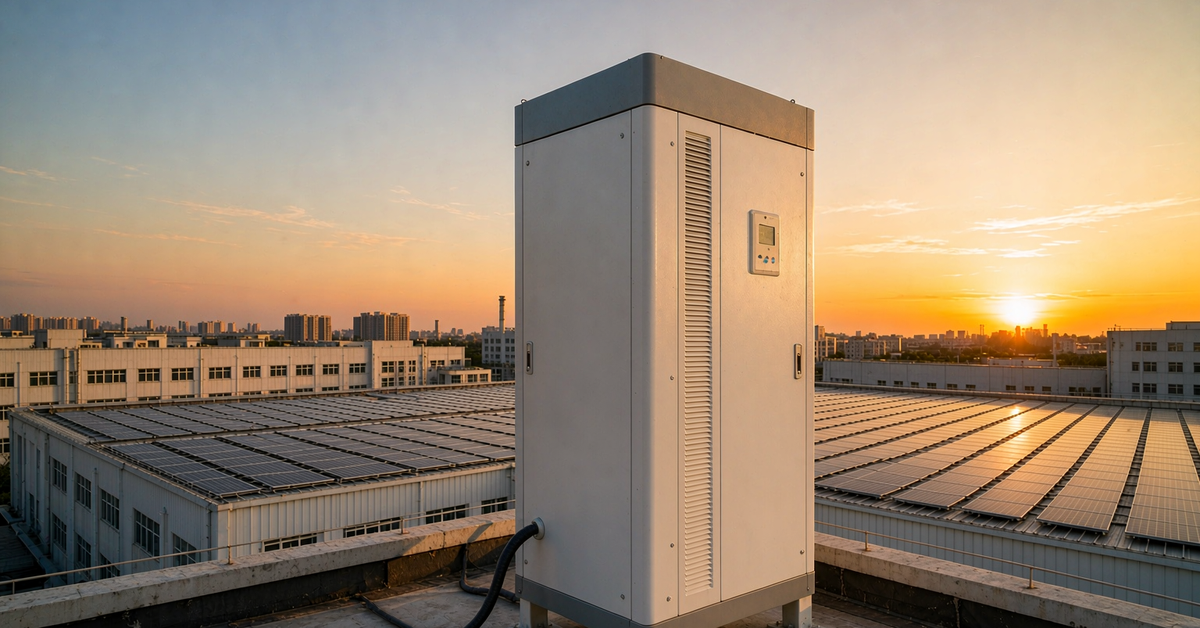
Water infrastructure spans every environment: coastal stations with salt air, highland pump houses with freezing winters, treatment basins with humid, chemically-laden atmospheres. The BR-261's envelope was designed for exactly this spread: −20°C to 55°C operation with built-in low-temperature heating, IP55 ingress protection, C4 corrosion resistance, and liquid cooling holding cell temperature ≤38°C at full load with ≤3°C cell-to-cell spread. Enclosure selection nuances between IP55 and IP65 are compared in our enclosure article.
Safety expectations in water utilities are among the strictest of any C&I sector, reflecting public-service scrutiny. The BR-261's layered design answers them: LFP chemistry, aerosol fire suppression at pack and system level, leakage-current detection, AC-side level-two lightning protection, an explosion-proof cabinet, 50 mm fire-resistant rock wool and at least one hour of fire resistance. Remote or unattended stations add one more requirement — full remote visibility — which the ETH, 4G, CAN, RS485 and LAN interfaces and cloud-edge collaboration provide, per the fleet monitoring model in remote monitoring and O&M.
Economics and the utility business case
Water-sector storage cases typically stack, in order of reliability:
- Demand charge elimination on pump-sequence peaks — the most bankable stream.
- Time-of-use shifting of base-loaded pumping energy.
- Avoided compliance and restart costs from ride-through, harder to quantify but often decisive in one prevented event.
- Solar self-consumption uplift where plants have or plan PV.
- Programme participation where the utility offers demand response or capacity payments.
The combined financial method — payback period, levelized cost of storage and value stacking — is set out in ROI, payback, LCOS and value stacking. One structural advantage water operators hold: facilities run 365 days a year without holiday lulls, so the battery earns every single day of its life.
FAQ
Can the battery run the whole plant during an outage?
Usually not, and it should not try. Storage carries the critical bus — controls, dosing, instrumentation and selected pumps — for hours at rated power; full-plant operation during extended outages requires generators in a combined arrangement. Define the critical bus by compliance need, not by plant size.
We already have reservoirs. Do we still need a battery?
Reservoirs store hydraulic energy; they cannot flatten electrical demand spikes within a pumping sequence, feed controls during a sag, or arbitrage tariffs at sites without pumping flexibility. The two are complements: schedule what the hydraulics allow, let the battery cover what they do not.
How does storage handle the inrush from large pump motors?
The converter's millisecond response absorbs the voltage effect of motor starts on the bus it protects, and its power factor range (−0.99 to +0.99 on the BR-261) lets it support voltage as well as real power. Pump starts become non-events for the demand meter.
Is outdoor installation acceptable at a treatment plant?
That is the design intent: IP55, C4 corrosion, a −20°C to 55°C envelope and a compact footprint (about 1.1 by 1.4 metres, 2.38 metres tall) let the cabinet sit on a pad near the switchgear. Follow fire-separation and access clearances per local rules.
What should we prepare for a feasibility study?
A year of interval power data, the SCADA pump log, the tariff sheet with demand charges, a single-line diagram and the list of loads that must ride through an outage. Water utilities usually have all of this on file already.
Next step
Send the interval data, pump schedule and critical-load list for your plant or station. We will model the demand-peak reduction, check the ride-through coverage for your compliance duties, and return a configuration with payback based on your actual operations. Request a quote from BR Solar.
Continue reading
- How to Size a 100kW 261kWh BESS for Peak Shaving
- Voltage Sags and Power Quality: How BESS Protects Production Lines
- Microgrid-Ready Storage for Remote Industrial Sites
- C&I Energy Storage ROI, Payback, LCOS and Value Stacking
Talk to a BR Solar storage engineer about your water infrastructure





