

Quick answer: A microgrid-ready battery provides four things a remote industrial site cannot get from the grid: black-start capability after an outage, support for a weak or unstable grid, smooth integration of solar or wind generation, and steady power for sensitive loads. The BR-261 cabinet brings 100 kW / 261 kWh with a −20 to 55°C operating range, low-temperature heating and ETH, 4G, CAN, RS485 and LAN communications for controller integration; the 5.01 MWh container scales that to megawatt-hour reserve for larger remote operations.
Why remote sites are different
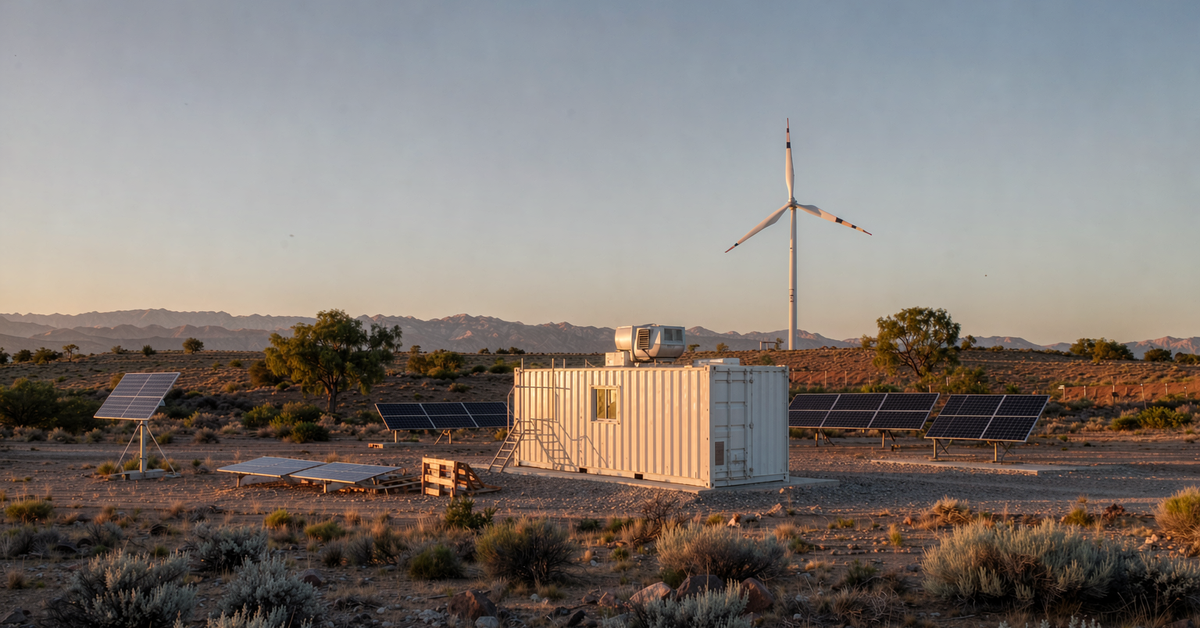
A remote mine, processing plant or island facility usually runs on a weak grid, a diesel genset, or an isolated network. Each has a failure mode that storage addresses. A weak grid sags under load and trips on faults; a genset is expensive per kilowatt-hour and slow to respond; a purely renewable site loses power when the wind drops or clouds cover the sun. Storage supplies the missing ingredient — instant, controllable power — and lets the site lean on cheaper generation without losing reliability.
Black start and grid-forming support
Black start is the ability to energise a network from a de-energised state without external power. On a remote site, that means the battery can re-establish voltage and frequency so loads and generators can come back online in a controlled sequence, rather than waiting for a grid that may not return. Related to this is grid-forming behaviour: supporting voltage and frequency on a weak network instead of merely following it. Storage is the natural source of both because it can supply power in milliseconds.
Integrating solar and wind without curtailment
Remote sites with renewable generation often cannot use everything they produce: output peaks when load is low, and a weak grid may limit how much can be exported or accepted. Storage absorbs the surplus and releases it when generation falls, raising the share of renewable energy the site actually uses. This is the same solar-shift logic described in solar plus storage for factories, applied where there is no strong grid to fall back on. The 5.01 MWh container carries temperature, smoke and combustible-gas detection with deflagration venting, which matters when an asset runs unattended in a harsh location.

Surviving the environment
Remote sites are hot, cold, dusty or all three. Enclosure and thermal design decide whether the system lasts. The BR-261 operates from −20°C to 55°C with integrated low-temperature heating, IP55 protection and C4 corrosion resistance, so it can discharge in cold conditions instead of derating. The container extends the operating range to −30 to 50°C with C5 corrosion protection optional, suited to harsher exposure. Communication options — ETH, 4G, CAN, RS485 and LAN on the cabinet; Ethernet, CAN and RS485 on the container — let the asset join a remote monitoring and dispatch system rather than requiring an operator on site.
A practical microgrid checklist
- Black-start capability and sequence of energisation.
- Grid-forming or grid-following mode and how it is set.
- Renewable surplus in kWh and the evening or wind-lull gap it must cover.
- Operating temperature range and low-temperature heating.
- Enclosure rating, corrosion grade and altitude limit.
- Communication protocols for controller and remote monitoring.
- Fuel savings versus diesel-only operation.
- Backup runtime for critical loads during extended outages.
FAQ
What does "black start" mean for a battery system?
It means the storage asset can energise the local network from a fully de-energised state, creating the voltage and frequency a site needs to restart loads and generators without waiting for the grid.
Can storage replace diesel on a remote site entirely?
Often it reduces diesel rather than eliminating it, because storage shifts and smooths renewable output but has finite energy. Many sites run a hybrid of storage, solar or wind, and a smaller backup genset; the split depends on the load and renewable resource.
How does the battery handle a weak grid?
It can supply power quickly to support voltage and frequency, and absorb surplus renewable generation, easing the strain on an unstable network. Confirm the operating mode with your system integrator, since grid-forming and grid-following serve different needs.
Will an outdoor cabinet work in extreme cold?
The BR-261 operates from −20°C to 55°C and includes low-temperature heating, which allows discharge in cold conditions. For colder or harsher exposure, the container's −30 to 50°C range and optional C5 corrosion protection are relevant.
How is the system monitored if no one is on site?
Through its communication interfaces. The cabinet offers ETH, 4G, CAN, RS485 and LAN; the container offers Ethernet, CAN and RS485, enabling cloud or remote supervisory control and diagnostics.
Next step
Tell us your generation mix, load profile and site conditions, and our engineers will design a microgrid around your actual constraints. Request a microgrid design from BR Solar.
Continue reading
- 5.01 MWh Container vs 261 kWh Cabinet
- Solar Plus Storage for Factories
- Virtual Capacity Expansion: How C&I Storage Defers Grid Upgrade Costs
- IP55 vs IP65 Enclosures for Outdoor C&I Energy Storage





