

Quick answer: Solar plus storage lets a factory use more of its own rooftop generation instead of exporting it at a low feed-in rate and buying power back in the evening at a high one. A battery such as the BR-261 stores midday PV surplus and discharges it during expensive evening hours or against demand peaks. The result is higher self-consumption, a lower demand charge and more resilience — provided the system is sized to the load profile, not to the array alone.

Why self-consumption is the real prize
A rooftop array on its own only saves money on the energy the site consumes while the sun is shining. Any surplus exported to the grid is usually bought back at a much lower feed-in tariff than the retail price the site pays in the evening. That gap is the value of storage: every kilowatt-hour you shift from export-and-buy-back to self-consumption captures the retail price instead of the feed-in rate. For a factory running one or two shifts, midday generation and evening load often do not overlap well, which is exactly when a battery earns its place.
How much that is worth depends on the tariff structure and the load shape; the mechanics are set out in our guide to C&I energy storage ROI and value stacking.
How the pair works through a factory day
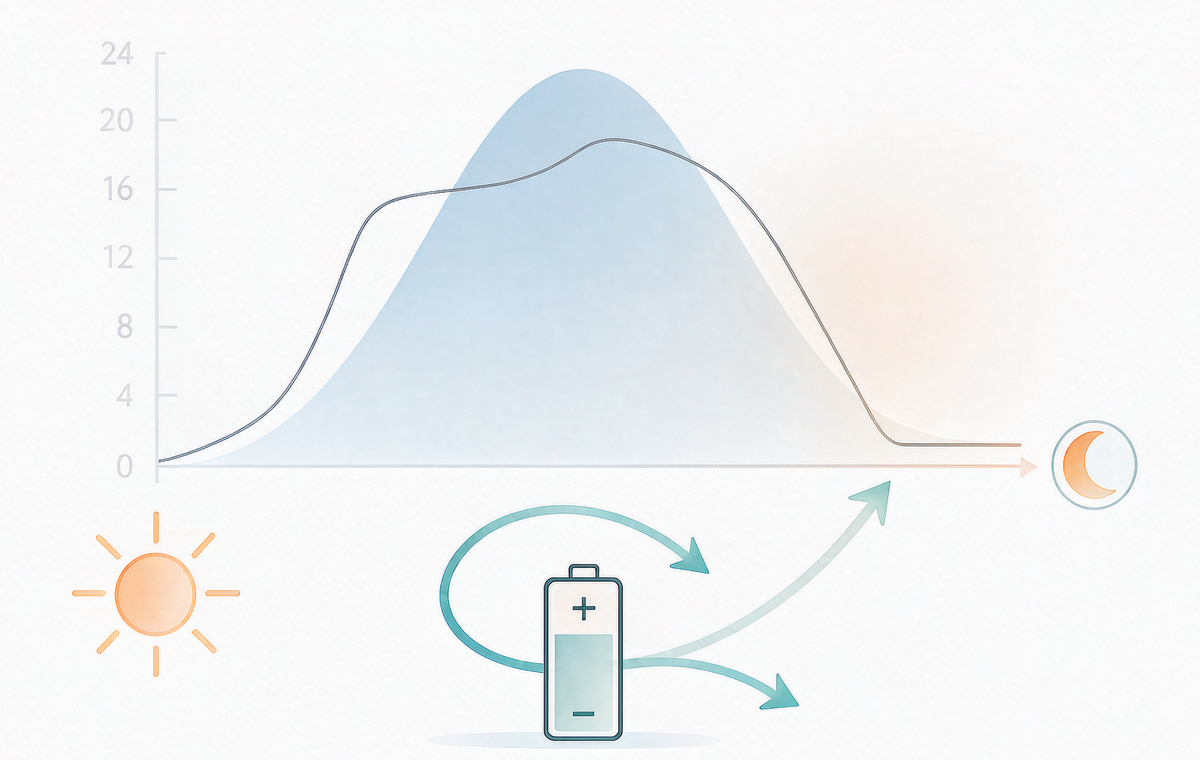
A typical commercial and industrial profile has three phases. In the morning, load rises as production starts; the PV array also begins generating but may not yet cover the load, so the site still imports. At midday, generation often exceeds the load, and the surplus is the energy worth storing. In the evening, generation falls away while load — especially cooling and lighting — persists into the expensive tariff band. Storage moves the midday surplus into that evening window instead of exporting it.
Sizing the battery to the load, not the array
The most common mistake is sizing storage to the solar array's output rather than to the site's consumption pattern and tariff. The right inputs are the same as for any storage project: interval load data, the tariff structure and the PV generation profile. A single BR-261 provides 100 kW of power and 261 kWh of capacity with ≥98.2% DC round-trip efficiency, and up to eight units run in parallel — so a factory can start with one cabinet and add units as the load or the array grows. If the site spans multiple buildings, the container scale described in 5.01 MWh container versus 261 kWh cabinet may fit better.
Where storage adds value beyond self-consumption
- Demand-charge reduction. Discharging against the site's monthly peak lowers the demand fee, stacking a second revenue stream on the same hardware.
- Backup for critical loads. A reserved state-of-charge floor keeps production-critical equipment running through a grid event.
- Demand response. Some markets pay for reducing load during grid stress events, which the same battery can deliver.
- Virtual capacity expansion. Shaving peaks can defer a costly grid connection upgrade — covered in virtual capacity expansion.
A practical checklist for solar-plus-storage
- 12 months of interval load data and the PV generation profile.
- The export/feed-in rate versus the retail and on-peak rates.
- Target self-consumption ratio and the evening energy gap in kWh.
- Demand-charge basis and the peak the battery should trim.
- Required backup energy and the critical-load list.
- Round-trip efficiency, DC or AC (≥98.2% DC on the BR-261).
- Number of cycles per day across all applications.
- Parallel expansion plan and reserved site space.
FAQ
Do I need storage if I already have solar panels?
Not strictly, but without storage a factory exports its midday surplus cheaply and buys back in the evening expensively. Storage is what converts that surplus into self-consumed energy and captures the retail-price saving.
How big a battery does a factory need for solar self-consumption?
Size to the evening energy gap you want to cover and to the demand peak you want to trim, using interval load data and the tariff. A single BR-261 at 100 kW / 261 kWh suits many medium factory profiles, with parallel units for larger sites.
Can the same battery do peak shaving and backup?
Yes. The BR-261 supports peak shaving, arbitrage, backup and demand response from the same hardware; the control strategy sets how much capacity is reserved for each duty.
What efficiency should I expect round-trip?
The BR-261 is stated at ≥98.2% maximum DC round-trip efficiency. Ask whether a quoted figure is DC or AC — AC includes the power conversion system and matches the number on your bill.
Is a cabinet or a container better for a large factory?
Use cabinets in the 100 kW / 261 kWh range and parallel them as needed; move to container scale for megawatt-hour demand from a single asset. The trade-offs are set out in our container-versus-cabinet comparison.
Next step
Send us your load data, your PV generation profile and your tariff sheet, and our engineers will size a solar-plus-storage system around your actual consumption. Request a solar-plus-storage design from BR Solar.
Continue reading
- How to Size a 100 kW 261 kWh BESS for Peak Shaving
- Virtual Capacity Expansion: How C&I Storage Defers Grid Upgrade Costs
- Data Center Backup Power with BESS
- How to Choose a Liquid-Cooled C&I Battery Cabinet
Talk to a BR Solar storage engineer about solar plus storage





