

Quick answer: A 6,000-cycle rating means the battery is expected to complete 6,000 full charge-discharge cycles while retaining at least 70% of its original capacity — under stated conditions of 25°C ±2°C and 0.5C charge and discharge. It is not a warranty of fixed output for a decade. Read the rating together with temperature, depth of discharge and the warranty's throughput or time limit, because those conditions decide how many real years 6,000 cycles becomes.
What 6,000 cycles does and does not promise
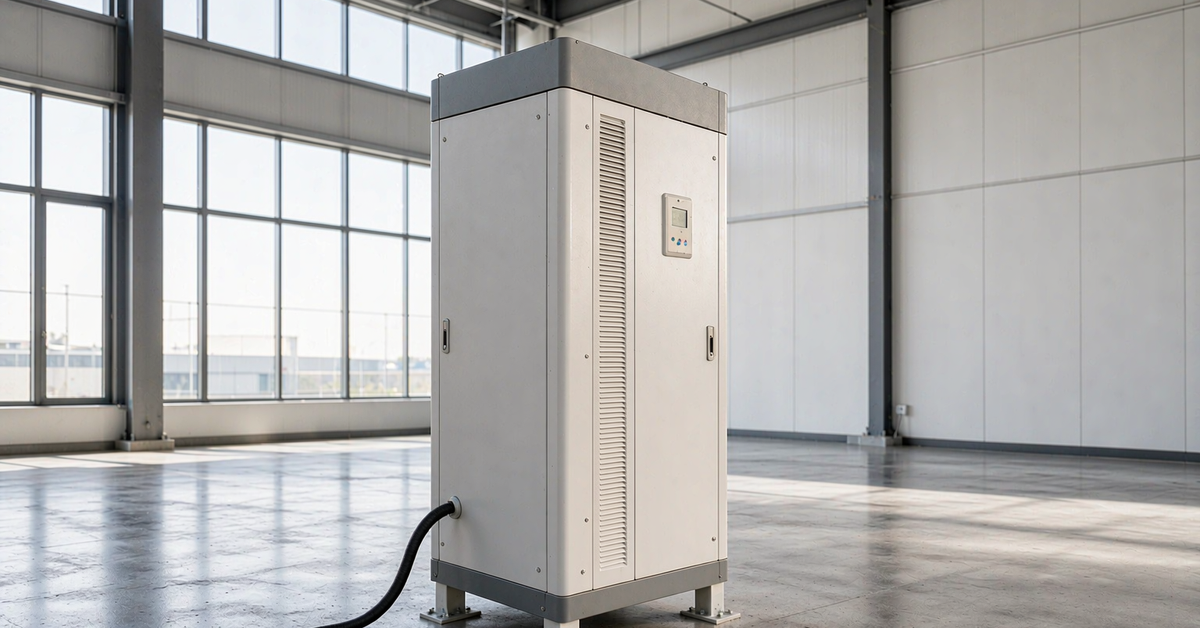
The BR-261 is rated at ≥6,000 cycles at 0.5C charge/discharge, 25°C ±2°C, to a remaining capacity of 70%. Two things matter here. First, the endpoint is 70% capacity, not zero — the battery still works at the end, just with less usable energy. Second, the number is conditioned on temperature and C-rate. Run the same cells hotter, or cycle them harder, and the achievable cycle count falls. A cycle rating is a performance statement under defined conditions, not a blanket guarantee.
Turning cycles into years
Years of service depend on how many cycles you run per day. One cycle per day — a single peak-shaving or solar-shift cycle — implies a long calendar life, but other limits intervene: the design lifespan is quoted at 10–15 years, and warranties usually cap either calendar time or total throughput, whichever comes first. Two cycles per day halves the calendar years a given cycle count supports. Before comparing suppliers, convert their cycle number into cycles per day for your duty and check it against the warranty term. Our ROI and LCOS guide shows how to weight this in payback.
Why temperature decides the real number
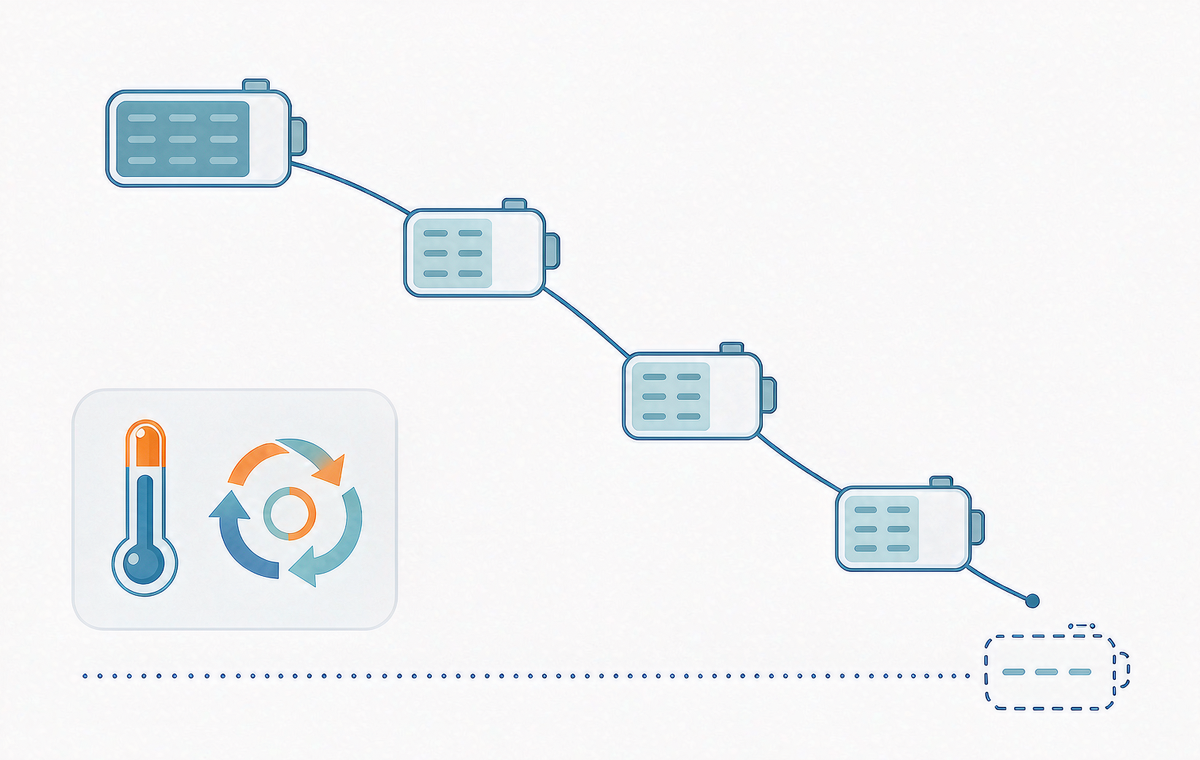
Heat is the dominant driver of LFP ageing. Cells that spend their life at a tightly controlled temperature age more slowly and more evenly than cells that swing hot and cold. This is why cooling design is not a comfort feature but a lifespan feature: the BR-261 keeps maximum battery temperature at or below 38°C and cell-to-cell difference within 3°C at full load, with low-temperature heating for cold starts. A cabinet that holds a narrow temperature band is, in effect, protecting the cycle rating you paid for.
Depth of discharge and how it compounds
Cycling a battery to a shallow depth usually extends its life compared with deep cycling. Many systems therefore reserve a state-of-charge band — for example, holding a floor for backup — which both protects the cells and caps the energy available for bill management. That trade-off is a design decision: more reserve means less billable energy. Ask how depth of discharge was assumed when the warranty throughput was set.
A practical warranty checklist
- Cycle count with its conditions — C-rate, temperature, end-of-life capacity.
- Calendar warranty term and any throughput cap.
- Design lifespan stated separately from the warranty (10–15 years on the BR-261).
- Temperature limits and how the warranty treats out-of-band operation.
- Assumed depth of discharge and reserved state-of-charge floor.
- What is covered if capacity falls below the stated threshold.
- Degradation curve, not just a single endpoint number.
- Effect of parallel operation on the warranty terms.
FAQ
Is 6,000 cycles a good number for LFP storage?
It is a competitive LFP figure for commercial storage and reflects thousands of daily charge-discharge cycles under controlled conditions. Judge it alongside temperature management, depth of discharge and the warranty term rather than in isolation.
Does the warranty last as long as the cycle rating?
Not necessarily. Warranties usually limit by calendar time or total throughput, whichever is reached first. Confirm both the cycle basis and the term in writing before you compare offers.
How can I make the battery last longer?
Keep it cool and evenly cooled, avoid unnecessary deep cycling, and reserve a sensible state-of-charge floor. Liquid cooling that holds cells within a narrow temperature band is the single most effective lever on a site.
What happens at 70% capacity?
The battery is at its end-of-life point by the cycle definition but still functions. Many sites keep using it for lower-demand duties even as full-capacity applications taper off.
Does fast charging shorten life?
Higher C-rates generally accelerate ageing compared with the 0.5C rating basis. If your duty requires faster charging, confirm the warranty still applies at that rate.
Next step
Share your expected cycles per day and your site's temperature conditions, and our engineers will confirm a realistic service life and warranty expectation. Request a lifecycle review from BR Solar.
Continue reading
- How to Choose a Liquid-Cooled C&I Battery Cabinet
- C&I Energy Storage ROI, Payback and LCOS
- IP55 vs IP65 Enclosures for Outdoor C&I Energy Storage
- 5.01 MWh Container vs 261 kWh Cabinet
Talk to a BR Solar storage engineer about battery lifespan and warranty






