

Why the cabinet matters in a home battery energy storage system
A home battery energy storage system is usually discussed in terms of usable kilowatt-hours, inverter compatibility, and backup runtime. Those matter, but the cabinet that holds the power electronics and storage modules can be just as important. It is the part that keeps the system organized, protected, serviceable, and, in many cases, safe enough to live with in a garage, utility room, or other residential setting.
That is easy to overlook when the conversation starts with solar battery storage. Yet the enclosure affects heat management, cable routing, service access, and how neatly the system fits into a home installation. For engineers and sourcing teams, the cabinet is not a cosmetic box. It is part of the electrical architecture.
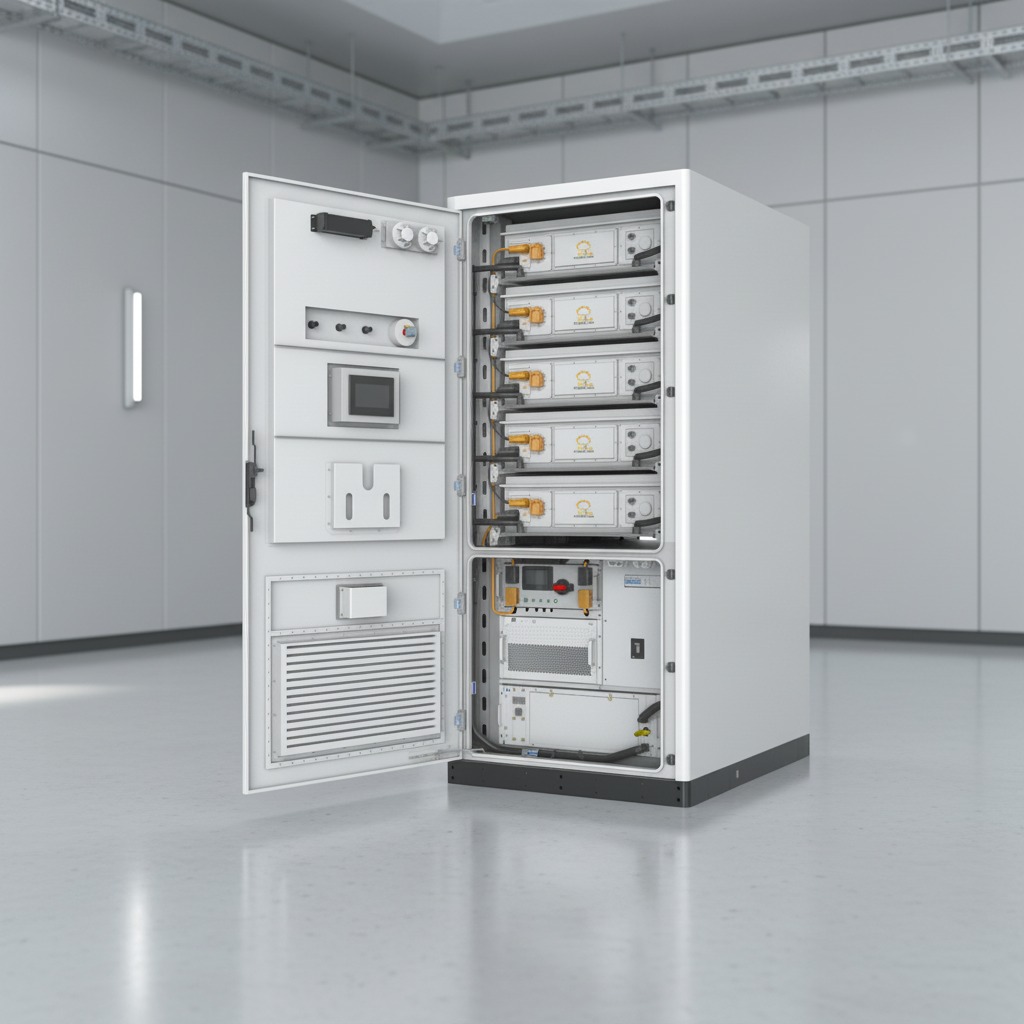
The image provided shows a tall, floor-standing metal cabinet with modular internal electronics, a front door with a small display area, and a lower control section. It appears to be a custom sheet-metal enclosure integrated with electrical assemblies. The exact product type cannot be confirmed from the image alone, but the layout is consistent with energy storage, power conversion, backup power, or related residential energy storage equipment.
What buyers are actually trying to decide
When someone evaluates a home battery energy storage system, the real decision is rarely “which box should we buy?” It is more often one of these:
Whether the system can be safely installed in the available space.
Whether the cabinet design supports maintenance without tearing apart the whole setup.
Whether the internal modules are arranged in a way that makes expansion or replacement practical.
Whether the enclosure will help, not hinder, thermal control and electrical separation.
Whether the system looks and behaves like a finished appliance rather than a collection of parts.
That is why the enclosure design deserves attention early in sourcing, not after the electrical team has already committed to the power architecture.
Quick comparison: what the cabinet design tells you
A home battery enclosure can take several forms, and the cabinet style often hints at the intended use case.
Floor-standing cabinet
This is the form most closely suggested by the product image. It offers more internal volume, cleaner module stacking, and easier cable organization. It also tends to suit systems that need multiple rack-mounted units or a separate control bay.
Wall-mounted compact unit
This style is common in smaller residential energy storage packages. It saves floor space, but it limits module depth and service access. It is not always the best choice when thermal load or expansion is a concern.
Split architecture
Some battery storage for home installations use separate battery packs, inverter units, and control electronics. That can simplify replacement of individual components, though it may create more installation complexity.
The cabinet shown here leans toward a modular, service-oriented architecture. That is useful when a buyer wants organized internal mounting and a front-access service path.
What is visible in the enclosure
The cabinet appears to be built from sheet metal with a light gray or white painted or powder-coated finish. The front door opens to reveal multiple identical horizontal modules stacked vertically, each with orange connector or locking features. A separate lower section appears to house control or power electronics, with vents and indicator elements visible.
A few practical observations matter here.
First, the repeated module layout suggests a modular internal architecture, which is often easier to assemble and maintain than a fully bespoke internal build. Second, the door-mounted display and control area suggest the system is intended for local monitoring or service interaction. Third, visible cable management and vertical mounting rails indicate that the cabinet is doing real integration work, not just acting as a shell.
That combination is exactly what many residential energy storage buyers want when they move beyond a simple battery pack.
Why sheet-metal fabrication is central to this kind of product
For this class of enclosure, custom sheet-metal fabrication is not a side note. It is the foundation.
A power cabinet like this needs precise cutouts for displays, vents, cable entries, hinges, fasteners, and mounting hardware. It needs rigid framing so the internal modules stay aligned under vibration and repeated service access. It also needs a finish that can hold up to handling, transport, and routine maintenance without looking battered after the first installation cycle.
In residential settings, buyers may also care about visual appearance more than they would in a plant room. A cabinet in a home utility space cannot look like something rescued from a factory floor. Even when function dominates, the enclosure still has to present as a clean, controlled piece of equipment.
That is one reason power-control enclosure design matters for solar battery storage projects. It affects both field performance and how readily the system is accepted by installers and homeowners.
Selection criteria that actually matter
If you are sourcing or specifying a home battery energy storage system, the cabinet should be reviewed alongside the electrochemistry and control logic. The most useful checks are practical ones.
Service access
Can technicians reach the modules, wiring, and control components without removing half the enclosure? Full-height front access is helpful, but only if internal layout supports it.
Thermal management
The image shows vents or louvered features in the lower section, but the exact cooling method is unknown. That matters. Residential systems can fail early if heat has nowhere to go, especially when cabinets are installed in enclosed rooms or warm garages.
Cable discipline
A tidy cabinet is not just for looks. It reduces installation errors and makes troubleshooting less painful. The visible mounting rails and routing paths are a positive sign, though the final quality depends on the build standard.
Module consistency
Identical stacked modules usually make procurement and assembly more predictable. They can also simplify spares planning, which is often overlooked until the first maintenance event.
Envelope and location fit
Home installations are space constrained. Even a technically strong system can become a poor buy if the cabinet footprint, door swing, or clearance requirements are awkward.
Common mistakes buyers make
The first mistake is treating the enclosure as a generic metal box. Once you do that, you tend to under-specify access panels, service clearances, and wiring separation.
The second mistake is focusing only on battery capacity and forgetting how the cabinet will be installed. A system can look attractive on a datasheet and still be a problem in a real home because the cabinet is too deep, too difficult to service, or too visually intrusive.
The third mistake is assuming all modular cabinets are the same internally. They are not. The quality of the panel assembly, the routing discipline, and the integration of the display or control interface can vary widely.
And one practical caution: if a supplier cannot explain the cabinet’s thermal concept, access logic, or maintenance sequence in plain terms, that is usually a warning sign. Not a deal-breaker every time, but worth probing.
Questions to ask suppliers
Before you commit to a residential energy storage cabinet or a related power-control enclosure, ask for specifics on the items that affect installation and support.
How is the internal module stack supported and isolated?
What is the intended service path for replacement or inspection?
How are cables separated from control elements?
What kind of ventilation approach is used?
Can the cabinet be adapted for different layouts, or is it fixed?
What parts of the system are integrated in-house versus externally sourced?
Those questions reveal more than a brochure does. They also help separate a polished enclosure from a genuinely supportable product.
Practical takeaway for sourcing teams
If you are evaluating battery storage for home projects, do not stop at chemistry, inverter rating, or app features. Study the enclosure as part of the product definition. The cabinet shown in the image suggests a modular, floor-standing architecture with service access, internal control hardware, and organized power-module mounting. That is a sensible direction for systems that need protection, maintainability, and a neat installation package.
For buyers, the decision is not whether a cabinet looks robust in a photo. It is whether the design will still make sense when an installer is on-site, a technician needs access, and the homeowner expects a quiet, orderly system that does not create new problems.
What to do next
If you are specifying a home battery energy storage system or reviewing cabinet-based solar battery storage hardware, build a short checklist around enclosure structure, cooling concept, service access, and cabinet integration quality. Then compare suppliers on those points, not just on headline capacity.
That approach usually surfaces the better product faster, especially when the exact internal hardware is still being finalized.






