
Why lifecycle cost analysis matters in street lighting decisions
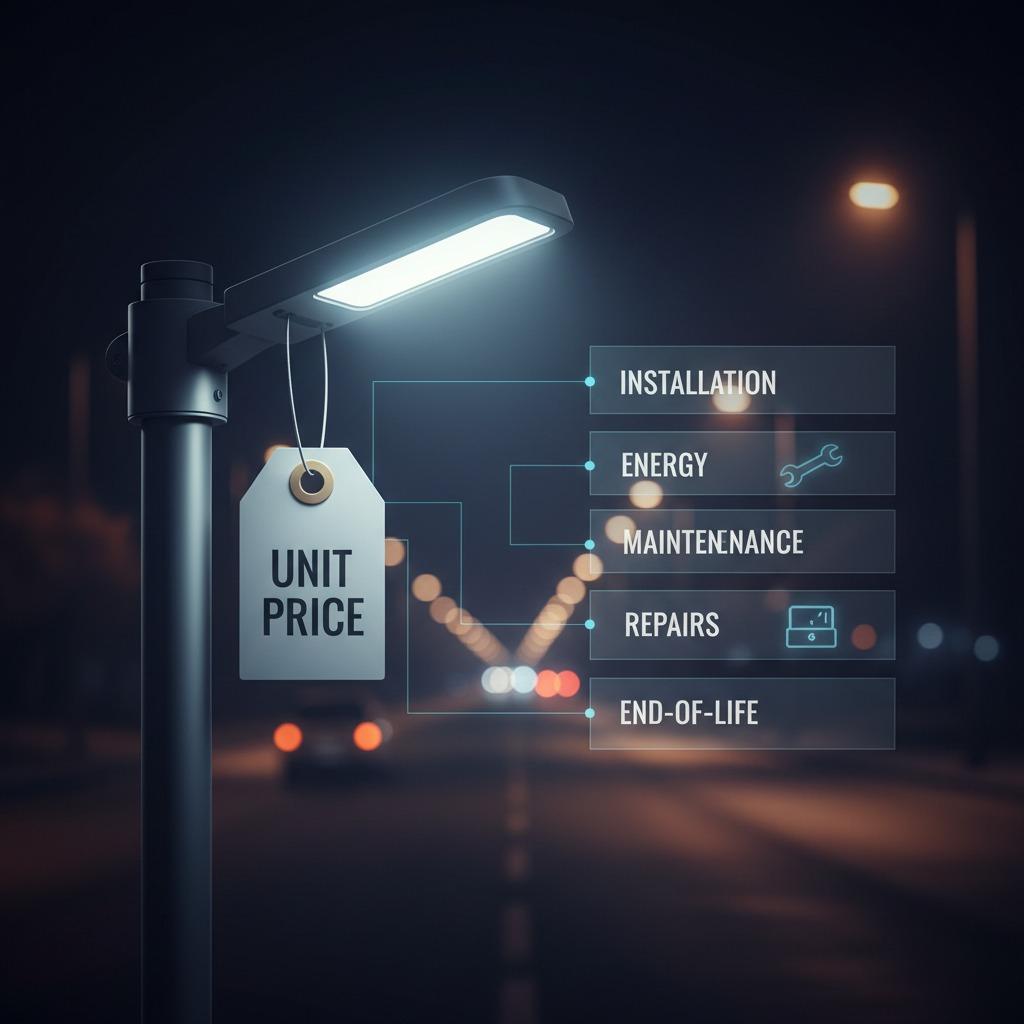
Procurement teams comparing luminaires often start with the same first question: what is the unit price? That is understandable, but for public lighting and large commercial sites, the smarter question is lifecycle cost analysis street lighting buyers rely on to see the full picture. A fixture that looks inexpensive on the quote sheet can become the costly option once installation, power consumption, maintenance access, lamp replacement, driver failures, and disposal are added up over years of service.
This matters because street lighting is not a one-time purchase. It is a long-running operating system exposed to weather, vibration, surges, dirt, and changing site expectations. Engineers and sourcing managers are usually trying to decide not just which lamp or luminaire is “best,” but which one will keep streets lit at an acceptable cost and with manageable maintenance risk. That is the decision this article is meant to support.
What lifecycle cost actually includes
A proper lifecycle view goes beyond capital expenditure. For street lighting, the total often includes the fixture itself, poles or brackets if they are part of the project scope, installation labor, electrical connections, commissioning, energy use, preventive maintenance, corrective maintenance, access equipment, replacement parts, and end-of-life handling. Depending on the project, downtime and traffic management costs may also be relevant. Those last items are easy to overlook and sometimes the most disruptive.
In practical terms, the buyer is trying to answer: if this light is installed today, what will it cost to own and operate over its service life? That ownership view is especially useful when comparing LED street luminaires, legacy high-intensity discharge systems, or different product tiers within the same technology family.
A simple comparison framework buyers can use
There is no single formula that fits every municipality or industrial campus, but a useful comparison usually looks like this:
1. Upfront cost
This is the easiest number to obtain, and the most deceptive when viewed alone. It should include the luminaire, mounting hardware if applicable, controls if specified, and installation labor. A low-cost fixture that needs custom adapters or more time in the field can quickly lose its price advantage.
2. Energy cost
Street lighting often runs many hours a night, so energy use becomes a major operating expense. Even modest reductions in wattage can matter over thousands of hours. This is where LEDs usually have a structural advantage, although actual savings depend on optical efficiency, control strategy, dimming schedule, and local electricity rates.
3. Maintenance cost
Maintenance is where the hidden budget pressure lives. Accessing a fixture on a busy road is not the same as replacing a lamp in a warehouse aisle. Labor, lift equipment, traffic control, and callout time all add up. A system with longer intervals between service events may be worth more than a lower-priced unit that needs frequent attention.
4. Reliability and failure profile
Not all failures are equal. A lamp that degrades gradually can be planned around. A driver failure on a critical corridor can trigger urgent service and public complaints. Buyers should pay attention to the likely failure modes of each option rather than assuming every “lifetime” claim means the same thing.
5. Disposal and replacement burden
End-of-life cost is usually smaller than energy or maintenance, but it still belongs in the model. Municipal buyers in particular may care about handling, recycling, and the administrative effort tied to retired equipment. It is not glamorous, but it is real.
Why LEDs often win, but not by default
Many lifecycle cost analysis street lighting studies point toward LED systems because they can reduce energy use and maintenance frequency. That broad conclusion is often correct, but it should not be treated as a blanket rule. Some projects have very specific optical, environmental, or control requirements. Some sites may already have infrastructure in place that changes the economics. In other cases, the cheapest LED option may not deliver the thermal performance or surge protection needed for a harsh outdoor environment.
The important point is not that LEDs are always better. It is that their value comes from the combination of lower wattage, long service intervals, and compatibility with controls such as dimming or scheduling. If a buyer ignores installation quality, control settings, or product reliability, the expected savings can shrink fast.
Key variables that change the result
Two lighting projects can use the same product and still produce very different lifecycle outcomes. The main variables are straightforward, though they are sometimes underestimated during early budgeting.
Operating hours matter first. A roadway on for 11 hours a night will produce a very different energy bill from a site lit longer or run at higher levels for safety reasons. Electricity price matters next, and rates can vary enough to alter the economic ranking of products. Maintenance access is another major factor: if every service call needs a bucket truck or lane closure, the cost of ownership rises quickly.
Environmental exposure also plays a large role. Coastal salt, strong wind, dust, heat, and surge-prone grids can shorten life or increase maintenance frequency. In those conditions, spec sheets that look fine on paper may not reflect real-world ownership cost. That is one reason buyers should be cautious with products that make bold lifetime claims without showing how those claims were derived.
Common mistakes in street lighting cost analysis
One frequent mistake is comparing a fixture price against a total-cost model from a different scope. If one quote includes controls, brackets, and commissioning while another includes only the luminaire, the comparison is already skewed. Another common issue is using assumed maintenance intervals that are more optimistic than field conditions justify. Engineers know this, but it still happens when a project is under pressure.
A second mistake is treating wattage as the only performance variable. Light output distribution, glare control, and mounting height affect how much light is actually useful on the pavement. A slightly more expensive fixture with better optics can lower the number of units required or support a lower wattage design. That can change the whole lifecycle equation.
It is also easy to ignore spare parts availability. If a driver, gasket, or lens is difficult to source later, the maintenance model becomes fragile. Procurement teams should ask not only whether a product is available now, but whether support parts and replacement families are likely to remain accessible through the expected service life.
How to evaluate bids without getting trapped by low first cost
When bids arrive, a practical buyer should normalize them before drawing conclusions. Compare on a common service life, a common operating schedule, and a common maintenance assumption. If the project uses controls, keep the control strategy consistent across all options. Then calculate total cost with enough detail to expose the main differences, not so much detail that the model becomes false precision.
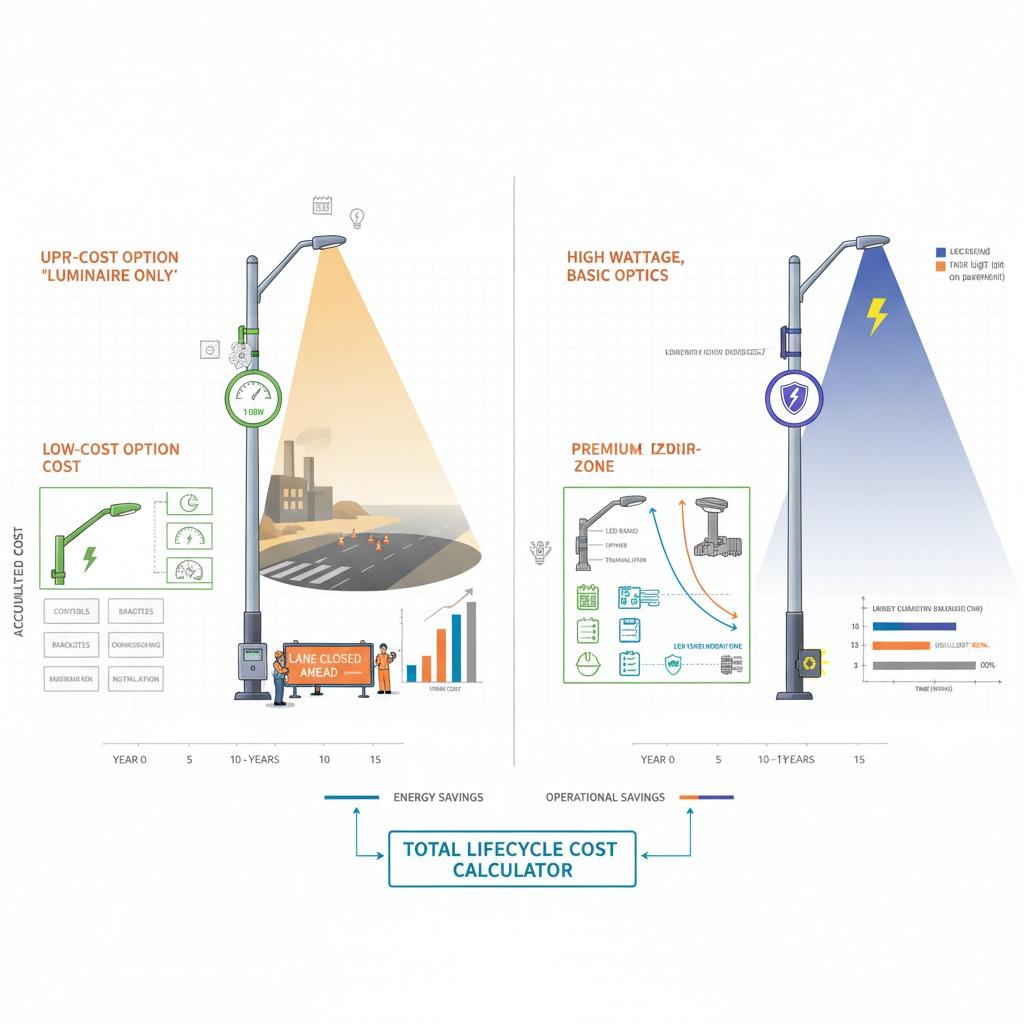
A sensible model often reveals one of three outcomes. The lowest-priced fixture may remain the best value if it is simple, durable, and easy to service. A mid-priced LED may outperform both cheaper and premium choices once energy and maintenance are counted. Or a premium system may justify itself on a difficult site where access costs dominate everything else. There is no shame in any of those outcomes; the shame is deciding before the numbers are actually compared.
What engineers should ask before approving a street lighting design
Before the design is frozen, it helps to ask a few direct questions. What assumptions were used for operating hours? What service life is being modeled, and is that service life supported by the product’s thermal and electrical design? How often will the luminaires be accessed, and at what cost per visit? Are surge conditions and environmental exposure accounted for? Does the selected control strategy reduce load in a way that is realistic for the site?
These questions do not require a perfect forecast. They do, however, keep the conversation tied to real operating cost instead of headline pricing.
FAQ: quick buyer questions
Is the cheapest street light always the lowest-cost option?
No. The cheapest purchase can become the most expensive once energy and maintenance are included.
Do all LED street lights have the same lifecycle cost?
Not at all. Driver quality, thermal design, optics, controls, and service access can change the result significantly.
Should municipalities use lifecycle analysis for every project?
For most public lighting projects, yes. Even a simplified model is better than buying on unit price alone.
A practical next step for sourcing and engineering teams
If you are preparing a tender or comparing replacement options, build a simple lifecycle model before you commit. Start with the actual operating schedule, add real maintenance assumptions, and test the result against more than one product type. That process will not eliminate uncertainty, but it will surface the costs that matter most.
For street lighting programs, the point is not to create the fanciest spreadsheet in the room. The point is to choose a system that delivers reliable illumination at a cost the owner can carry for years. That is where lifecycle cost analysis earns its place in the decision.