

Quick answer: Fast EV charging is brutal on an electrical connection: each DC dispenser can draw 150 kW or more, so even a modest four-gun site can demand close to a megawatt at busy times. Battery storage turns that problem around. A battery energy storage system (BESS) charges quietly off-peak or from on-site solar, then co-discharges with the grid connection during rush hours, so a site can serve far more charging power than its grid feed alone would allow. That means smaller transformer upgrades, lower demand charges, and faster deployment in places where a grid upgrade would take years. A 100 kW / 261 kWh cabinet is the building block; sites scale by paralleling units.
Why charging hubs hit the grid so hard
A highway charging plaza or urban charging hub concentrates power demand in a way few commercial loads do. Utilization is spiky: several vehicles may plug in within minutes of each other during morning and evening rushes, each pulling high power for 20 to 40 minutes. Between rushes the site idles. The result is a load profile with extreme peaks and deep valleys, and everything about the economics flows from that shape.
The pain shows up in three places. First, the grid connection itself: utilities size transformers and feeders for the peak, so a site with 600 kW of dispensers needs a connection approaching that size even if the average draw is a fraction of it. Upgrades of that kind mean new transformers, trenching, switchgear and often months or years of utility queues. Second, demand charges: the utility bills the single highest demand interval, so one busy Saturday afternoon sets the cost for the whole month. Third, stranded capacity: hardware installed for peak demand sits idle most of the day, earning nothing.
How storage relieves each problem
- Connection size relief (capex). With a BESS co-discharging during peaks, the utility service can be smaller than the installed charging capacity. A site with a 400 kW grid feed plus storage can serve 600 kW or more of dispensers, avoiding or deferring a costly upgrade. Storage used this way is essentially the same principle as virtual capacity expansion, applied to a charging business.
- Demand charge control. The battery covers the gap between the site's demand cap and the actual charging draw, so the metered peak stays flat even on the busiest day. For charging operators, this is often the difference between a profitable tariff and a loss-making one.
- Time-of-use arbitrage. Charging demand usually peaks in the late afternoon and evening, exactly when grid electricity is most expensive in many markets. Storage charges overnight at off-peak rates and discharges into the evening rush, converting a wide spread into margin.
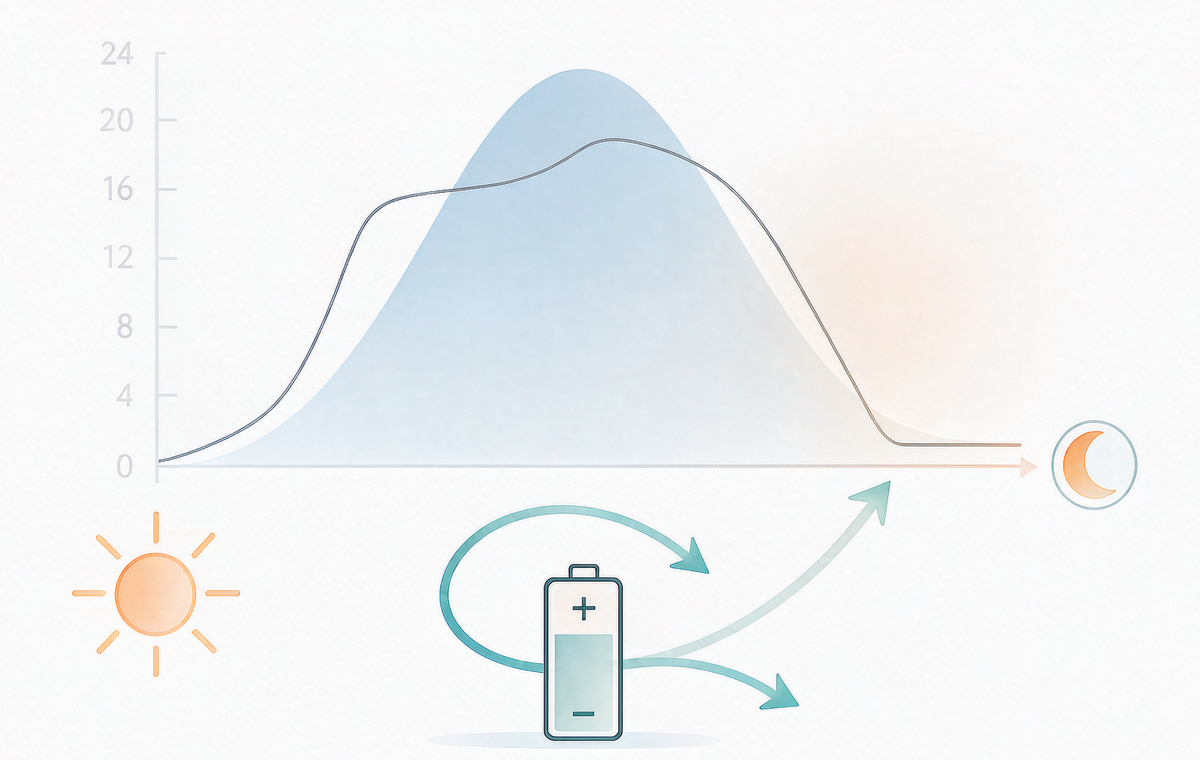
- Solar pairing. Canopy solar over the parking area produces through the day, while charging demand peaks later. Storage time-shifts that energy so the site actually sells its own electrons at rush hour, a pattern detailed in solar carport plus storage.
- Power quality and ride-through. The battery's converter responds in milliseconds to load steps, steadying the bus voltage as chargers ramp, and carrying the site through brief sags.
Sizing a BESS for a charging site
Step 1: measure utilization, not nameplate
Dispenser nameplate adds up fast, but what matters is the coincident demand profile: how many vehicles actually charge at once, for how long, at what power. Pull at least several months of session data from the charging management system and build the 15-minute demand profile. Compare the average busy-period demand against the grid connection limit; the gap between them is the job the battery must do.
Step 2: set power and energy separately
Power (kW) sets how hard the battery can push during the rush; energy (kWh) sets how long it can sustain the push. One BR-261 cabinet provides 100 kW and 261 kWh, roughly 2.5 hours at full output. If the morning and evening peaks each last 60 to 90 minutes and the grid feed covers the rest, one or two units fit. If sessions run longer or peaks are heavier, BR-261 units parallel up to eight, reaching 800 kW / 2,088 kWh, and the platform grows without redesign. Our step-by-step sizing method is in sizing a BESS for peak shaving.
Step 3: model the throughput duty
A charging-hub battery works harder than most: it may cycle once or even twice a day, every day. That duty profile raises the importance of cycle life and thermal management. The BR-261's LFP pack is rated ≥6,000 cycles at 0.5C/0.5C, 25°C ±2°C, to 70% end of life, and liquid cooling holds cell temperature below 38°C at full load with cell-to-cell spread within 3°C, both of which protect lifetime under heavy cycling. Read how cycle-life figures translate into warranty value in LFP cycle life and warranty.
Deployment realities: speed, space and outdoors
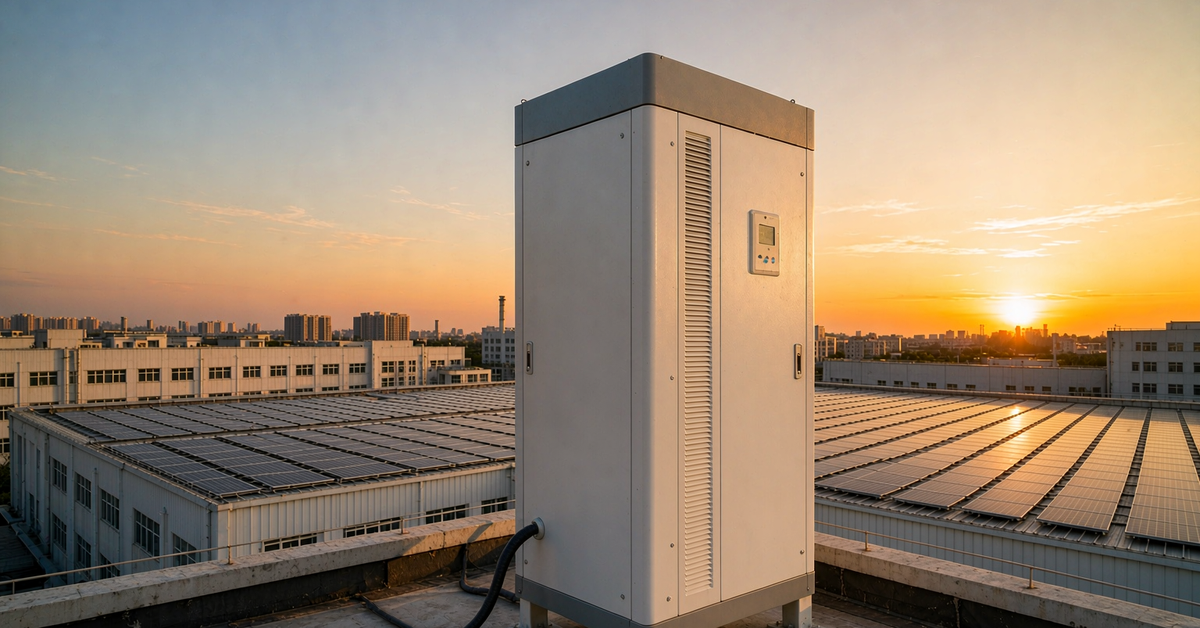
Storage's biggest advantage at a charging hub may be speed. Utility transformer upgrades can take many months or longer; an outdoor battery cabinet installs in weeks. The BR-261 is an outdoor all-in-one unit with IP55 protection, C4 corrosion resistance and operation from −20°C to 55°C, so it sits beside the chargers on a concrete pad without a building. EMS, PCS and BMS are integrated in one enclosure, and communication options include ETH, 4G, CAN, RS485 and LAN for integration with the site's charge management system and the utility meter.
Space is modest: the cabinet's footprint is about 1.1 by 1.4 metres and stands 2.38 metres tall. Keep the required clearances, respect fire-separation distances, and plan the cable route from the main panel. Safety is engineered in layers: LFP chemistry, aerosol fire suppression at pack and system level, an explosion-proof cabinet, 50 mm of fire-resistant rock wool, AC-side level-two lightning protection and leakage-current detection. Our article on battery fire safety covers the full stack, which matters anywhere the public charges vehicles nearby.
What the business case looks like
Charging-hub storage economics stack four items:
- Avoided or deferred upgrade capex. The hardest saving to quantify and often the largest; a transformer upgrade avoided is pure project feasibility gained.
- Demand charge savings every month, from capping the metered peak.
- Arbitrage margin from off-peak charging and on-peak discharge.
- Higher utilization made possible by serving more vehicles than the raw connection otherwise allows, which grows revenue rather than just cutting cost.
How these streams combine into payback and levelized cost is treated in depth in our article on ROI, payback and value stacking.
FAQ
Can storage fully replace a grid upgrade?
It depends on utilization growth. Storage comfortably covers daily peaks and defers upgrades for years in most cases; a site whose average demand grows past what the connection plus battery can serve will eventually still need a larger feed. The right framing is "defer and size smartly," not "eliminate forever."
How fast does the battery respond to a vehicle plugging in?
The power conversion system responds within milliseconds, and the site controller dispatches the battery against the demand cap in real time. Drivers notice nothing; the battery simply absorbs the step so the grid connection does not.
Does the battery work in cold climates?
Yes. The BR-261 operates from −20°C to 55°C and includes built-in low-temperature heating, so winter mornings at a highway plaza do not stop charging or discharge.
Can we start with one cabinet and expand later?
That is the intended path. Up to eight BR-261 units run in parallel, so a site can start with one 100 kW / 261 kWh block sized to today's demand and add blocks as utilization grows, without changing the platform or control system.
What data do you need to size our site?
Charging session logs (start, stop, power per session), the grid connection limit, the tariff sheet with demand charges, and any solar canopy plans. Those four inputs are enough for a firm configuration and payback estimate.
Next step
Send your charging session data, connection limit and tariff sheet. We will model the coincident demand profile, size the battery against your real rush-hour shape, and show the payback with and without a grid upgrade. Request a quote from BR Solar.
Continue reading
- Battery Storage for EV Charging Hubs and Fleet Depots
- How to Size a 100kW 261kWh BESS for Peak Shaving
- Solar Carport Plus Storage for Commercial Parking
- Virtual Capacity Expansion: How C&I Storage Defers Grid Upgrades






