

Quick answer: A solar carport turns a parking lot from dead space into a power plant, and battery storage fixes its one structural weakness: the mismatch between when canopies produce (midday) and when the host building or charging load peaks (evening). Pairing a canopy array with a 100 kW / 261 kWh battery cabinet such as the BR-261 raises self-consumption, cuts demand charges, feeds EV chargers without a grid upgrade, and turns the parking area into visible proof of a company's energy strategy. The combination works best where parking is large, daytime loads are moderate, and evening demand — whether building load or vehicle charging — is the expensive part.

Why parking lots are suddenly energy assets
Commercial parking is enormous, paved, unshaded and empty of any other productive use — and it sits directly next to the meter you are already paying. Retail centres, supermarkets, logistics yards, hospitals, hotels, factories and corporate campuses all hold hundreds or thousands of square metres of it. A canopy structure puts photovoltaic modules above the parking rows, close to the electrical infrastructure, with no land acquisition and no competing land use. Vehicles get shade and weather protection; the meter gets generation.
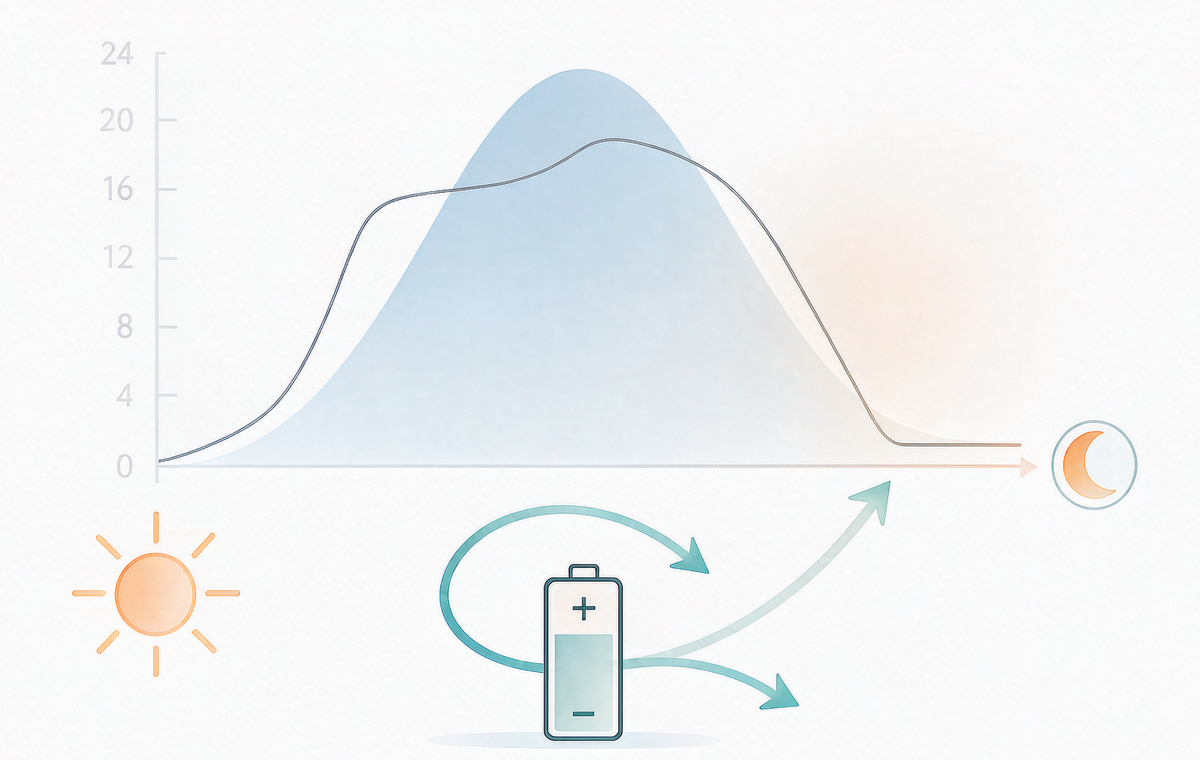
But a carport alone inherits solar's classic flaw: generation peaks at midday, while commercial demand typically peaks in the late afternoon and evening. In markets where exported solar earns little or nothing, every kilowatt-hour the canopies produce beyond the building's midday appetite is wasted value. That gap is precisely what storage closes, and it is the same self-consumption logic applied at factory scale in solar plus storage for factories, adapted to the distinctive shape of parking-based generation.
What storage adds to a carport project
- Self-consumption uplift. The battery absorbs midday surplus that the building cannot use and releases it through the evening peak, converting exported or curtailed energy into avoided imports at the expensive tariff.
- Demand charge control. Evening peaks set the monthly demand charge. Storage discharges across that window so the canopies' absence at peak no longer costs money at the meter.
- EV charging without a grid upgrade. Chargers in the same parking area draw heavily exactly when canopies produce nothing. The battery bridges the gap, letting a site install more charging capacity than its grid feed would otherwise allow — the core mechanism described in battery storage for EV charging hubs.
- Backup for selected loads. Where the site's critical circuits (tills, cold cases, control systems) are wired to the storage bus, the cabinet carries them through brief outages and sags.
- Demonstration value. A shaded, solar-covered parking lot with visible battery cabinets is the most legible sustainability statement a property can make; customers and tenants understand it without a report.
Sizing the combination
Start from the parking lot and the load shape
Three inputs drive the design: the canopy's expected generation profile, the host building's load curve, and — if chargers are planned — the expected charging sessions. Overlay the generation curve on the demand curve; the area where generation exceeds demand is what the battery must catch, and the evening deficit is what it must return. For a typical retail or office site, a single 100 kW / 261 kWh cabinet handles the surplus of a moderately sized canopy and covers a two-to-three-hour evening peak.
Match power to the evening problem
The battery's power rating must cover the evening demand above the target cap — whether that demand is building load, charger sessions, or both combined. One BR-261 delivers 100 kW; sites with heavier evening peaks parallel up to eight units for 800 kW / 2,088 kWh without changing platform or controls. The systematic method — interval data, cap selection, validation — is set out in our peak-shaving sizing guide.
Design the electrical topology deliberately
Decide early whether the battery, the canopies and the chargers share one low-voltage bus behind the main meter (simplest, captures all value streams) or split into sub-arrays. Keep cable runs short: canopies and cabinets should sit near the main switchboard. Confirm where export is even permitted, since in several markets storage behind the meter becomes financially attractive precisely because export is not.
Outdoor equipment: the cabinet belongs outside anyway
A parking lot is an outdoor electrical environment: dust, rain, sun, and sometimes salt air near coasts or roads treated in winter. Outdoor-rated storage is a requirement, not a preference. The BR-261 carries IP55 protection and C4 corrosion resistance, operates from −20°C to 55°C with built-in low-temperature heating, and integrates EMS, PCS and BMS in one cabinet of roughly 1.1 by 1.4 metres footprint. Liquid cooling keeps cell temperature ≤38°C at full load with cell-to-cell spread ≤3°C — the specification that lets the system cycle daily for years beside a sun-baked asphalt surface. The enclosure trade-offs between IP55 and IP65 are compared in our enclosure article, and the full safety stack — LFP chemistry, pack- and system-level aerosol suppression, explosion-proof cabinet, 50 mm rock wool, one-hour fire resistance — is itemised in battery fire safety.
Placement deserves thought: cabinets near the switchboard shorten DC and AC runs; clearances keep service access; bollards or kerbs protect against vehicle contact; and fire-separation distances to occupied structures follow local rules. The cabinet should be visible — it is part of the story the site tells.
Economics: how the value stacks
A carport-plus-storage business case combines several streams, ranked by typical reliability:
- Avoided grid imports at peak tariff — every stored kilowatt-hour displaces the most expensive electricity the site buys.
- Demand charge reduction — capping the evening peak lowers the monthly demand line.
- Charging revenue uplift — where EV chargers exist, storage enables more dispensers and higher utilization than the grid feed alone.
- Avoided upgrade capex — the combination frequently avoids transformer upgrades that the chargers alone would have triggered.
- Incentives and programmes — where available, investment support or demand response participation adds margin.
Canopies add their own economics — generation with zero land cost — and the two assets share one connection, one meter and one story. The full method for combining streams into payback and levelized cost is covered in ROI, payback, LCOS and value stacking.
FAQ
Can the battery charge only from the canopies?
It can, and solar-only charging is cleanest, but limiting the battery to surplus alone forfeits arbitrage value in markets with wide peak-valley spreads. Most sites charge from both, prioritising surplus; the dispatch strategy follows the tariff.
Do the cabinets take parking spaces?
The BR-261's footprint is roughly 1.1 by 1.4 metres. A cabinet pair with clearances fits in the space of one or two parking bays, ideally at the edge of the lot near the switchboard, where the land value is lowest and cable runs shortest.
What about winter, when canopies produce less?
Storage keeps working; it simply shifts strategy from catching surplus to tariff arbitrage — charging off-peak and discharging into the evening. The system's value does not vanish in winter; it changes source. Built-in low-temperature heating keeps the pack safe in freezing conditions.
Can we phase the project — canopies first, storage later?
Yes, and many owners do. But design the electrical infrastructure for storage from day one: space at the switchboard, cable routes and a place for the cabinet. Retrofitting storage into a carport built without provision costs more than planning for it.
Does shade from the canopy structure hurt generation?
Well-designed canopies place modules above the parking envelope with appropriate tilt and string layout, so losses are modest. This is a canopy design question rather than a storage question, but it belongs in the same feasibility study.
Next step
Bring the parking area dimensions, the building's interval load data, the canopy plan if one exists, and any EV charging roadmap. We will model generation against demand, size the cabinet against the evening deficit, and show the combined payback. Request a quote from BR Solar.
Continue reading
- Solar Plus Storage for Factories: Raising Self-Consumption with BR-261
- Battery Storage for EV Charging Hubs: Capex Relief and Power Boost
- C&I Energy Storage ROI, Payback, LCOS and Value Stacking
- IP55 vs IP65 Enclosures for Outdoor C&I Energy Storage
Talk to a BR Solar storage engineer about your carport project





