

Quick answer: Behind-the-meter (BTM) storage sits on your side of the utility meter — between the grid and your loads — so every kilowatt-hour it moves reduces what you buy at retail prices rather than exporting at wholesale rates. Commercial and industrial sites use BTM batteries for four bill lines: demand-charge reduction by clipping peaks, energy-cost reduction by shifting consumption from peak-priced to valley-priced hours, higher solar self-consumption by storing midday PV surplus for evening use, and grid-capacity relief that defers transformer upgrades. A 100 kW / 261 kWh liquid-cooled cabinet like the BR-261 executes all four under one EMS schedule, and the savings compound across every billing period.

Front-of-meter versus behind-the-meter
The meter is the boundary that decides the economics. Front-of-meter (FTM) assets sell services to the grid or utility and earn wholesale or contracted prices. Behind-the-meter assets serve the host site and displace purchases at the retail rate — which includes not just the energy price but demand charges, and sometimes capacity or power-factor penalties. That retail-to-wholesale spread is why a modest battery can be strongly economic on a factory site even when grid-scale projects earn far less per kilowatt-hour.
BTM also changes the engineering conversation. The asset's job is not market trading; it is matching your load curve, your tariff calendar and your physical constraints (transformer size, switchboard capacity, available space). Everything in this article follows from that site-first perspective.
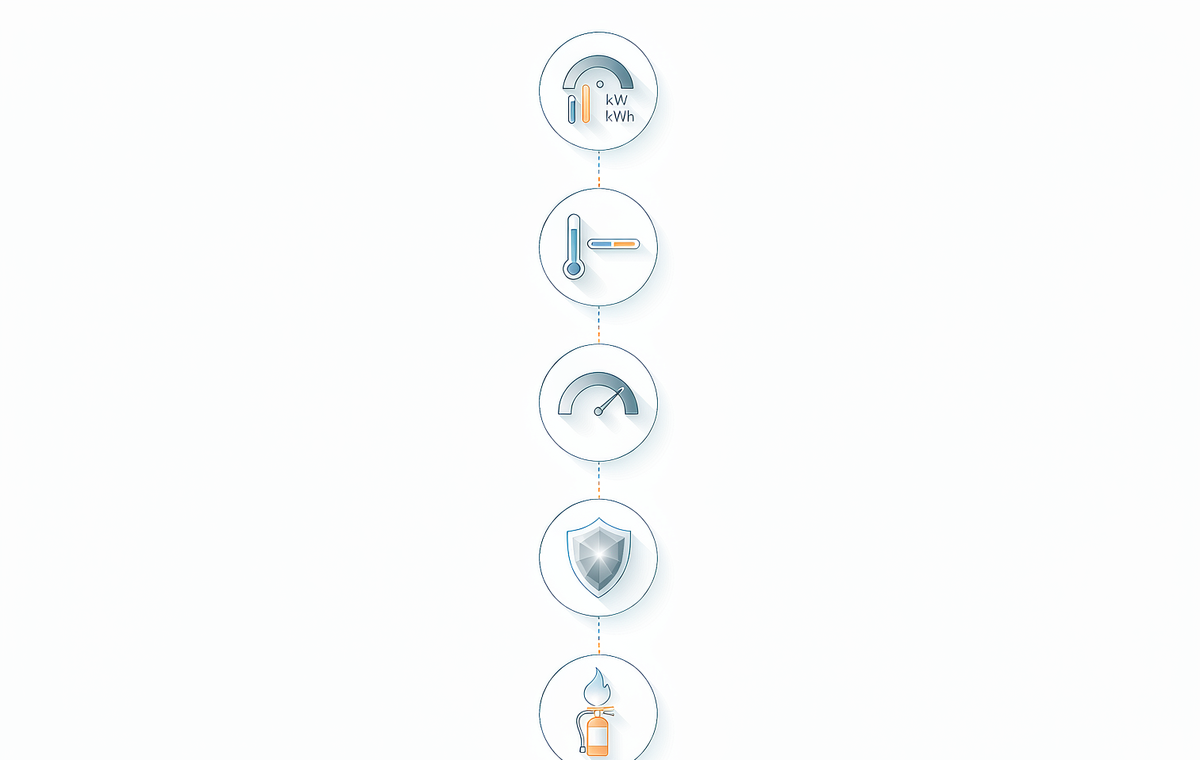
The four ways BTM storage cuts the bill
1. Demand-charge reduction
Most industrial tariffs bill a monthly fee based on the single highest power draw. The EMS watches site power and clips every interval that would set a new maximum; a 100 kW cabinet removes up to 100 kW from the billed peak, month after month. Because the saving depends on your load shape rather than market prices, it is the most predictable line and usually pays back first. Full mechanics in demand-charge management with battery storage.
2. Load shifting across tariff periods
Where time-of-use pricing applies, the battery charges in valley hours (or from PV surplus) and discharges into peak hours, converting a price spread into savings every day. Two daily cycles are sustainable on hardware rated for the duty — the BR-261 carries ≥6,000 cycles at 0.5C/0.5C, 25°C ±2°C, to 70% end of life. Strategy selection between shifting and shaving is compared in peak shaving versus load shifting.
3. Solar self-consumption
On sites with rooftop PV, midday generation often exceeds load, and surplus exports earn little. The battery absorbs the surplus and returns it during the evening peak, multiplying the value of every solar kilowatt-hour. This pairing is the core of solar plus storage for factories and applies equally to warehouses, cold stores and commercial roofs.
4. Capacity relief and deferred upgrades
When growth is capped by transformer headroom rather than tariff cost, BTM storage extends the usable envelope: peaks that would overload the transformer are served from the battery instead. This virtual capacity expansion defers expensive utility upgrades and lets a site add production capacity years earlier than a new interconnection would allow.
Where the cabinet physically sits
A BTM installation connects on the site's low-voltage side, typically at or near the main distribution board. The BR-261 simplifies the connection: an outdoor all-in-one enclosure integrating EMS, PCS and BMS, rated IP55 with C4 corrosion protection for direct ground installation, delivering 144 A rated output on a 380/400 V three-phase, five-wire supply. Key site considerations:
- Point of connection and metering. The control loop needs site power measurement at the metering point; confirm the meter's communication interface so the EMS reads load in real time.
- Footprint and siting. The cabinet occupies roughly 1100 × 1400 mm of plan area on a foundation, outdoors, within the fire-separation and access rules summarized in battery fire safety.
- Protection and compliance. Existing switchgear protection settings are reviewed for the new bidirectional connection; the cabinet's AC-side level-two lightning protection, leakage detection and fault alarms integrate into the site's electrical safety scheme.
- Communications. ETH, 4G, CAN, RS485 and LAN options cover plant networks and remote monitoring; cloud-edge collaboration keeps local control alive even if the internet link drops.
What the savings look like in practice
A realistic BTM business case stacks the lines rather than betting on one. An illustrative mid-size factory (figures for demonstration only) might see: a demand-charge line that repeats every month regardless of energy prices; an arbitrage line that scales with the local peak-valley spread and the system's ≥98.2% maximum DC round-trip efficiency; a solar line that grows as PV surplus is captured instead of exported; and, where relevant, avoided upgrade costs from capacity relief. The formal framework for combining them — payback period, levelized cost of storage and value stacking — is laid out in C&I energy storage ROI, payback and value stacking.
Two honest caveats belong in every proposal. First, BTM savings depend on tariff structure: a site on a flat, spread-less tariff earns mainly from demand charges, and the analysis must be tariff-specific. Second, batteries are not generators: for full backup coverage of entire facilities, storage pairs with generators or is sized to the critical-load subset, as discussed for data center backup power and hotels and resorts.
FAQ
What does behind-the-meter actually mean?
It means the storage system connects on the customer side of the utility meter, serving site loads directly. Energy it discharges is energy you do not buy at retail prices; energy it absorbs is surplus you would otherwise export cheaply or waste.
How is BTM different from a grid-scale battery farm?
Grid-scale assets earn from wholesale markets and utility contracts; BTM assets earn from your own bill — demand charges, time-of-use spreads and solar self-consumption. BTM economics are site-specific but usually higher per kilowatt-hour, because displaced energy is valued at retail rates.
Can BTM storage work without solar?
Absolutely. Demand-charge clipping and tariff arbitrage are pure grid-interactive strategies that need only a suitable tariff and load shape. Solar adds a third value stream but is not a prerequisite.
Will the battery power my factory in an outage?
It can carry selected critical circuits, and with proper transfer design it provides meaningful ride-through — a single BR-261 supplies roughly 2.6 hours at full 100 kW output under ideal conditions, longer at lighter loads. Whole-facility backup requires larger parallel fleets or generator pairing; hospitals and data centers typically combine the two.
Does BTM storage need utility approval?
Because it connects to the grid, yes — typically a notification or application process, interconnection review and inspection before energization. The scope varies by market and capacity; the process outline is in grid connection and permitting for C&I storage projects.
Next step
Send one recent electricity bill and, if available, interval load data for your site. We will quantify each of the four savings lines against your actual tariff, recommend the cabinet configuration, and state the expected payback with the assumptions visible. Request a behind-the-meter savings analysis from BR Solar.
Continue reading
- Demand Charge Management with Battery Storage for Factories
- Peak Shaving vs Load Shifting: Which Strategy Fits Your Tariff
- C&I Energy Storage ROI: Payback, LCOS and Value Stacking
- Solar Plus Storage for Factories: Raising Self-Consumption
Talk to a BR Solar storage engineer about your electricity bill





