

Quick answer: Refrigerated warehouses and food processing plants are among the best fits for C&I battery storage. Refrigeration compressors run around the clock, hold a high, predictable baseload, and drive some of the steepest demand charges in any industry. A 100 kW / 261 kWh liquid-cooled cabinet such as the BR-261 shaves evening peaks, shifts load away from expensive tariff windows, protects refrigeration during brief grid events, and even performs better in cold climates, since it operates from −20°C to 55°C. Most facilities recover the investment through demand charge reduction, tariff arbitrage and avoided spoilage rather than any single revenue stream.
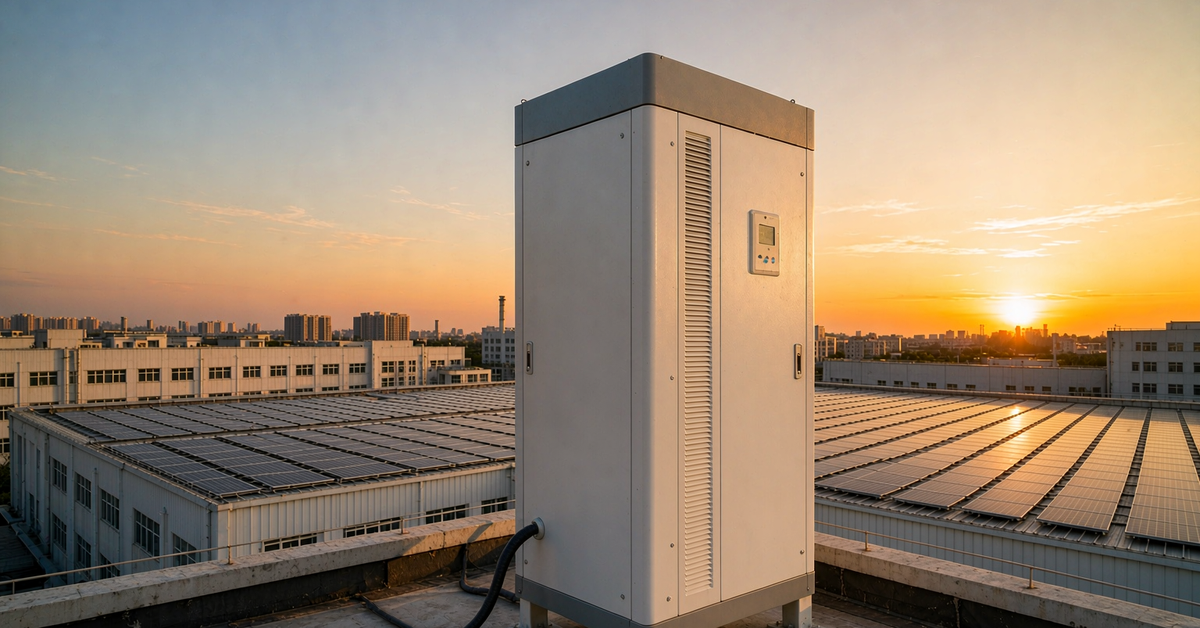
Why refrigeration loads are a special case for storage
Cold storage is not a typical commercial load. A refrigerated warehouse runs compressors, evaporator fans and defrost cycles twenty-four hours a day, and the load barely drops at night. Food processing plants add washdown equipment, freezing tunnels, packaging lines and ammonia refrigeration systems on top of that baseload. The result is a demand profile that is high, flat and expensive, because many tariffs charge not only for the energy consumed but for the single highest demand interval in the billing month.
That demand charge is where battery storage earns its keep. Because the refrigeration load is so predictable, a battery energy storage system (BESS) can forecast the evening peak with unusual accuracy and discharge precisely when the facility would otherwise set a new monthly maximum. Unlike office buildings or retail sites, a cold store rarely has a wild, unpredictable load shape, so the storage system does not need to be oversized to catch rare spikes. The cleaner the load profile, the smaller and cheaper the BESS needed to cut it.
Refrigeration also offers a form of flexibility that few other loads have: thermal inertia. A cold room that is pulled down to temperature in the morning will coast for hours before warming toward its limit. That inertia can be exploited deliberately, by pre-cooling before a tariff peak and letting the compressors rest while the battery or the stored cold carries the site through the expensive window. Storage and thermal mass together give the facility two buffers instead of one.
What a BESS actually does in a cold-chain facility
In practice, the same 261 kWh cabinet serves several jobs at once, and the value stacks:
- Demand charge reduction. The battery discharges across the daily peak intervals so the utility meter never sees the full combined compressor load. This is usually the largest and most reliable saving.
- Peak and off-peak arbitrage. Where tariffs differ strongly between day and night, the system charges overnight at the cheap rate and discharges through the afternoon peak. Cold stores suit this well because they consume steadily and can absorb a full daily cycle.
- Backup for critical refrigeration. During a grid outage or voltage sag, stored energy keeps control systems, monitoring and selected compressor circuits alive, protecting product value while generators start or the grid recovers.
- Solar self-consumption. Roof-mounted PV over a warehouse is large and cheap, but its output rarely matches the refrigeration profile. Storage absorbs the midday surplus and returns it in the evening, a pattern described in our guide to solar plus storage for factories.
- Demand response revenue. Where the utility or aggregator pays for load reduction events, a facility with storage can participate without touching the refrigeration itself.
No single item on this list always pays for the system alone. Stacked together, they routinely do. The logic of combining revenue streams is covered in more depth in our article on ROI, payback and value stacking.
Sizing storage for a refrigerated warehouse
Start from interval data
Request twelve months of 15-minute interval data from the utility or the site meter. Mark the top demand events of each month, the tariff windows, and the load level the site would like to cap. For a mid-size cold store, a common starting point is a 100 kW power limit, which is exactly what one BR-261 cabinet delivers at full output. The 261 kWh capacity then determines how long that cap can be held, roughly 2.5 hours at rated power, which covers most evening peak windows.
Match the power-to-energy ratio to the load
Refrigeration peaks are usually broad rather than spiky, lasting one to three hours. That favours a moderate power-to-energy ratio rather than a high-power, short-duration unit. If the site peaks harder or longer, up to eight BR-261 units can run in parallel, scaling to 800 kW / 2,088 kWh before any redesign is needed. The step-by-step method is set out in our guide to sizing a BESS for peak shaving.
Leave headroom for pre-cooling strategy
If the operating team wants to pre-cool rooms before a peak window, the battery must cover the residual compressor load while the refrigeration plant ramps down. Model this scenario explicitly with the interval data rather than assuming the average peak is representative, because pre-cooling changes the shape of the day.

Siting and environment: cold is an ally, with caveats
Cold ambient temperatures are usually a problem for battery rooms, but a well-engineered outdoor cabinet turns them into a non-issue. The BR-261 is specified for operation from −20°C to 55°C and includes built-in low-temperature heating, so the pack charges safely even on winter mornings. Liquid cooling keeps cell temperature below 38°C at full load and holds cell-to-cell difference within 3°C, which matters in summer when the compressor yard is hot and the sun is on the enclosure.
Placement still needs care. Keep clearances for service access, respect local fire-separation distances from the building and from ammonia plant, and choose a position where the cable run from the main switchboard is short. For washdown-heavy food processing areas, the cabinet's IP55 rating and C4 corrosion protection handle dust and most industrial atmospheres; the trade-offs between IP55 and IP65 are compared in our article on outdoor enclosure selection.
Food safety, backup and the role of storage
A BESS is not a substitute for a standby generator on a large cold store, and it should not be sold as one. What it does provide is ride-through: seconds to minutes of clean power that keep control panels, monitoring, lighting and selected refrigeration circuits running through a voltage sag or while a generator starts. That ride-through window is often what separates a minor event from a written-off production run. Facilities with strict food-safety audits also value the logging: the battery management system records every event, giving auditors a timestamped power-quality history. For facilities where continuity requirements are severe, our article on voltage sags and production uptime explains how storage handles dips and momentary interruptions.
Safety engineering deserves equal scrutiny. LFP chemistry, aerosol fire suppression at pack and system level, an explosion-proof cabinet, 50 mm of fire-resistant rock wool and at least one hour of fire resistance are standard on the BR-261. Food facilities often have insurers and auditors who ask for exactly this list; our article on battery fire safety walks through each layer.
Economics: where the savings come from
A cold-chain storage business case is built from four components, in rough order of reliability:
- Demand charge savings from capping the monthly peak, usually the largest and most predictable item.
- Tariff arbitrage from charging off-peak and discharging on-peak, strong in markets with wide peak-valley spreads.
- Avoided losses from ride-through during sags and short outages, intermittent but often very large per event.
- Programme revenue from demand response or capacity schemes, where available.
Because refrigeration loads cycle every day, the battery completes more cycles per year than in most commercial applications, which pushes the levelized cost of stored energy down. Cycle life is therefore a key economic input: the BR-261's LFP pack is rated at ≥6,000 cycles at 0.5C/0.5C, 25°C ±2°C, to 70% end of life, and the way to read that figure is explained in our article on LFP cycle life and warranty.
FAQ
Does cold weather damage the battery?
LFP cells should not be charged when too cold, which is why the BR-261 includes built-in low-temperature heating and is rated to operate and discharge down to −20°C. In practice, cold climates are easier on battery enclosures than hot ones, because the cooling system works less hard and cell aging slows.
Can the BESS carry the whole refrigeration plant during an outage?
Not usually, and it does not need to. One 100 kW cabinet carries controls, monitoring, lighting and a selected set of compressor circuits for a couple of hours, which bridges generator start or grid recovery. Facilities that must keep full freezing capacity online regardless of grid condition pair storage with a generator in a microgrid arrangement.
How much roof solar can the system absorb?
The cabinet absorbs PV surplus up to its charging capability and shifts it to the evening. Exact solar sizing depends on the roof array and the surplus profile; a mid-day surplus in the 50 to 100 kW range pairs naturally with one 100 kW / 261 kWh unit. Larger arrays add parallel units.
Will one cabinet be enough for our site?
Check the top demand intervals against the 100 kW cap. If the peak above the target cap lasts under roughly 2.5 hours and the excess demand stays under 100 kW, one unit suffices. If not, BR-261 units parallel up to eight, so the same platform scales without changing technology.
What data should we send for a proposal?
Twelve months of interval load data, the tariff sheet, a single-line diagram of the main switchboard and a list of circuits that must stay powered during an outage. With those, a configuration can be sized against real constraints.
Next step
Send your interval data and tariff sheet, and flag which refrigeration circuits are critical during an outage. Our engineering team will model the peak-shaving case, check the ride-through coverage and return a configuration and payback estimate based on your actual load, not industry averages. Request a quote from BR Solar.
Continue reading
- How to Size a 100kW 261kWh BESS for Peak Shaving
- C&I Energy Storage ROI, Payback, LCOS and Value Stacking
- Battery Fire Safety in Commercial Energy Storage
- Solar Plus Storage for Factories
Talk to a BR Solar storage engineer about your cold-chain site





