

Quick answer: Liquid cooling holds every cell in a narrow temperature band — on the BR-261 the battery stays at or below 38°C at full load with cell-to-cell difference within 3°C — which protects cycle life, output consistency and safety in daily-cycled commercial systems. Air cooling is simpler and cheaper upfront but cannot maintain that uniformity in hot climates or under sustained high rates. For C&I cabinets that cycle every day for a decade, liquid cooling is the engineering default; air cooling can suit light-duty, mild-climate, backup-oriented installations where cycling is rare.

What temperature does to a lithium battery
Lithium iron phosphate (LFP) cells age faster at high temperature, charge poorly below freezing, and lose usable capacity unevenly when different cells operate at different temperatures. Three failure modes follow directly from thermal management, and they compound each other:
- Accelerated aging at high temperature. For every sustained increment of cell temperature, degradation reactions run faster, so the pack reaches its end-of-life capacity threshold sooner than the datasheet's cycle count suggests.
- Charging limits in the cold. Lithium plating risk rises when charging at low cell temperature. Without heating, a cabinet on a cold morning must derate or refuse to charge — exactly when a peak-shaving schedule needs it.
- Imbalance across the pack. The hottest cells degrade fastest and drift in capacity from the coolest. The whole string is then limited by its weakest cell, so the pack's usable energy tracks the worst cell, not the average.
Cell-to-cell temperature difference is therefore a first-order specification, not a footnote. A spread of 3°C or less — the BR-261 reference point — keeps the pack balanced; a wider spread quietly converts a rated cycle life into a lower delivered one. Our article on LFP cycle life and warranty shows how test conditions relate to field reality.
How air cooling works, and where it falls short
Air cooling blows forced ambient air across cells and heat sinks. It has genuine advantages: fewer components, no coolant loops to maintain, lower capital cost, and simpler service. For installations that discharge occasionally — backup duty, occasional demand spikes, mild climates with generous derating margins — air cooling is a rational choice.
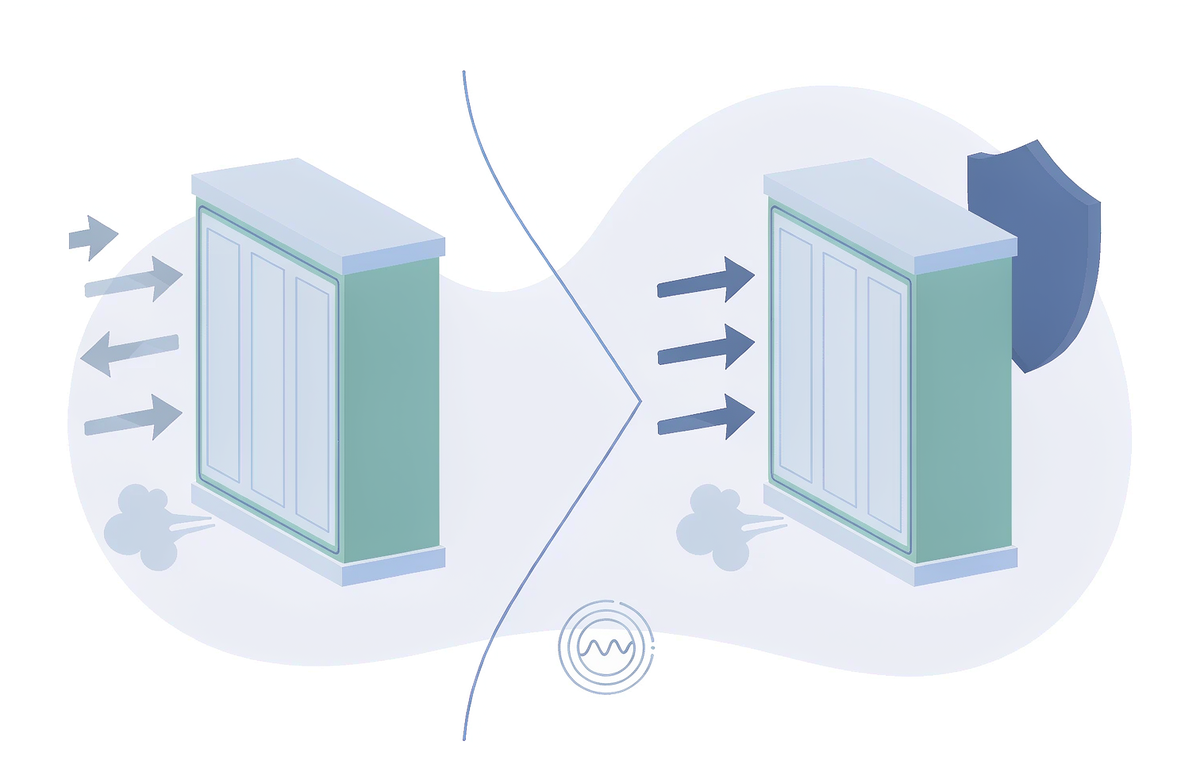
Its shortfall appears under sustained, high-rate duty in warm environments. Air has low heat capacity, so removing kilowatts of heat from densely packed cells requires large airflow, large temperature difference between inlet air and cells, and careful duct design. The result, in real cabinets, is a temperature field that stratifies: cells near the inlet run cool, cells near the exhaust run hot, and the spread grows with rack depth and charge rate. Filters also load up with dust in industrial parks, degrading airflow over time and requiring scheduled maintenance that outdoor C&I sites often neglect.
There is a second-order effect buyers rarely see quoted: an air-cooled cabinet that must stay cool may reduce power or limit charge rate on hot afternoons — precisely when peak-shaving value is highest. Thermal derating on the hottest days is a silent revenue cut.
How liquid cooling works, and what it buys you
A liquid-cooled cabinet pumps coolant through cold plates in direct contact with cells or modules, then rejects the heat through an external exchanger. Liquid's heat capacity is far higher than air's, so the same heat removal happens with much smaller temperature differences and much tighter control. The practical consequences for a C&I buyer:
- Tight uniformity. BR-261 specifies battery temperature at or below 38°C at full load and cell-to-cell difference within 3°C, which is what lets the pack sustain ≥6,000 cycles at 0.5C/0.5C, 25°C ±2°C, to 70% end of life without the hottest cells dragging the pack down.
- No thermal derating on hot days. The cabinet delivers rated 100 kW output across its −20 to 55°C operating envelope instead of throttling when ambient soars.
- Built-in cold-weather capability. The BR-261 includes low-temperature heating, enabling discharge to −20°C — the heating loop and the cooling loop share the same thermal circuit.
- Higher energy density. Because cooling hardware is compact and airflow clearances are unnecessary, more energy fits in the same footprint; the BR-261 packs 261 kWh into a 1100 × 1400 × 2380 mm outdoor cabinet.
- Lower acoustic signature and ingress control. With smaller fans and a sealed enclosure, IP55 protection against dust and water jets is easier to maintain than on a cabinet that needs continuous air exchange with a dusty environment.
The costs are equally real: a coolant loop with a pump and exchanger adds components and requires periodic coolant service, and the enclosure must be engineered against leaks. Buyers should ask any liquid-cooled supplier about coolant type, service interval, leak detection and pump redundancy — questions our general guide on choosing a liquid-cooled C&I battery cabinet includes in the evaluation checklist.
Decision framework by application
- Factories and industrial parks cycling daily. Liquid cooling. High ambient, dust, and daily deep cycles make the temperature-uniformity premium self-funding through preserved cycle life and no hot-day derating.
- Solar plus storage with evening shifting. Liquid cooling, especially where midday charging at high rate coincides with peak ambient temperature. See solar plus storage for factories.
- Backup-oriented or infrequently cycled sites in mild climates. Air cooling can be acceptable if the duty is light and the room is conditioned; weigh the lower upfront cost against the risk when duty grows.
- Coastal, marine or corrosive environments. Liquid cooling with a sealed enclosure pairs better with C4 (or C5) corrosion requirements; check the enclosure discussion in IP55 versus IP65 enclosures.
- Hot climates anywhere. Liquid cooling. The gap between the technologies widens as ambient temperature rises.
What to ask on both sides of the comparison
When a supplier proposes either technology, put the same questions to both:
- Maximum cell temperature at rated continuous power, and cell-to-cell difference at full load.
- Any power or charge-rate derating above a stated ambient temperature — and what output remains at your site's summer design temperature.
- Coolant service interval, pump and fan redundancy, and leak detection for liquid systems; filter service and airflow verification for air systems.
- Cycle-life rating with full test conditions, and whether the warranty assumes your climate.
- Noise level at 1 metre, if the cabinet sits near offices or neighbours.
The answers convert a technology preference into a site-specific comparison. A liquid-cooled cabinet specified with 38°C maximum battery temperature and 3°C spread will hold its published efficiency — BR-261 states ≥98.2% maximum DC round-trip efficiency — because the conversion electronics and cells both operate in controlled conditions.
FAQ
Is liquid cooling worth the extra cost for a small 100 kW site?
For daily-cycled duty, yes: preserved cycle life, no hot-day derating and tighter efficiency outweigh the premium within the first years of operation. For backup-only or rarely cycled duty in a mild climate, air cooling's simplicity can win. Base the decision on cycling frequency and ambient, not on technology fashion.
Does liquid cooling add leak or freeze risk?
A well-engineered loop is sealed, monitored and uses coolant rated for the full operating range; the BR-261 operates from −20 to 55°C with its thermal system integral to that envelope. Ask the supplier for leak-detection provisions and the coolant service schedule as part of the quote.
Why do air-cooled cabinets derate on hot days?
Because their heat rejection depends on ambient air temperature, and as the air-to-cell temperature difference shrinks, they must cut power or charge rate to stay within cell limits. That derating lands exactly in tariff-peak afternoon hours, cutting savings when value is highest.
What is cell-to-cell temperature difference and why 3°C?
It is the spread between the hottest and coolest cells in the pack during operation. The pack ages as fast as its hottest cell, so a small spread keeps capacity balanced. The BR-261's ≤3°C figure is a strong reference point; anything wider reduces effective cycle life below the datasheet rating.
Does liquid cooling affect safety?
It reduces one safety stressor — sustained high temperature — but it does not replace the fire-safety stack. Look for pack- and system-level suppression, explosion-proof construction and fire-resistant materials; BR-261 combines liquid cooling with aerosol suppression, an explosion-proof cabinet, 50 mm rock wool and at least one hour of fire resistance, as detailed in battery fire safety for commercial storage.
Next step
Send us your site's climate data, load profile and duty expectation. We will confirm whether liquid cooling pays back at your location, quote the BR-261 with its full thermal specification, and state the derating-free output you can expect at your summer design temperature. Request a thermal-specified quote from BR Solar.
Continue reading
- How to Choose a Liquid-Cooled C&I Battery Cabinet
- IP55 vs IP65 Enclosures for Outdoor C&I Energy Storage
- 6,000 Cycles Explained: LFP Cycle Life and Warranty
- 5.01MWh Container vs 261kWh Cabinet
Talk to a BR Solar storage engineer about cooling for your site





